
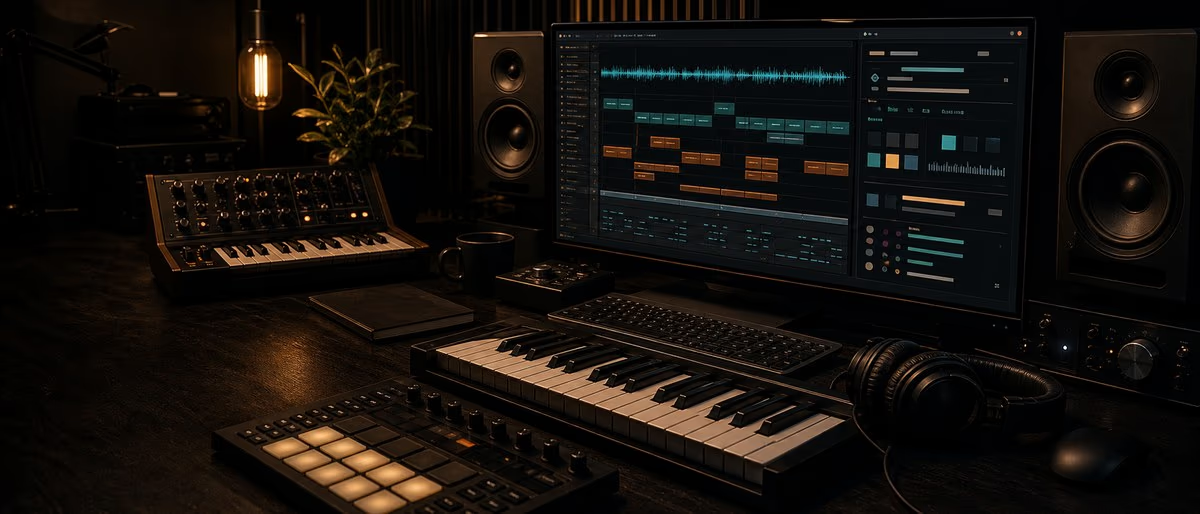
The AI Music Tools Landscape in 2026
Suno vs Udio vs LANDR: Which AI Tool Actually Works
AI Vocals, Stems, and the Stem Separation Reality
Integrating AI Into Your Production Workflow
AI Ethics, Copyright, and Platform Policies in 2026
The Future: Will AI Replace Music Producers?
Learning path
Related answer hubs
Music Production for Beginners Music production for beginners: a simple roadmap from first DAW to finished beat. A beginner music producer should pick one DAW, learn basic MIDI and drum programming, use a small set of free plugins and samples, finish a short beat, export it, and repeat the process weekly. Finishing tracks is mor... Sound Design Sound design: synthesis basics, bass design, presets, and usable sounds. Sound design is the process of creating or reshaping sounds with oscillators, samples, filters, envelopes, LFOs, effects, and layering. Beginners should learn one synth, build simple basses, leads, pads, and plucks, t... Free VST Plugins Free VST plugins: what to download first and how to use them safely. The best free VST plugin setup for most producers is one flexible synth, one EQ, one compressor, one reverb, one delay, and one metering tool. Vital or Surge XT can cover synthesis, TDR Nova can cover EQ, DC1A or TDR ...
Ready to explore AI-assisted mastering and mixing tools?
Browse Free DownloadsAI Music Production: Common Questions
- Can I use Suno or Udio generated music commercially?
- Suno's Pro tier ($20/month) grants a commercial license for generated tracks. The free tier restricts commercial use. Udio similarly requires a Pro subscription for commercial rights. Always verify the current license terms on each platform before releasing — policies change frequently in 2026.
- Does Spotify accept AI-generated music?
- Spotify accepts AI-generated music if properly disclosed in metadata. Artists must tag tracks with 'AI Generated' or similar metadata flags depending on distributor requirements. Undisclosed AI music can be removed under Spotify's synthetic media policy.
- What AI tools are best for mastering?
- LANDR remains the most established AI mastering service with genre-aware processing. iZotope Ozone 13 includes AI assistant features that suggest EQ and compression settings. Gullfoss and ADP Meridian offer real-time AI mixing assistance. For $0-50/month, LANDR and Ozone cover most mastering needs.
- Can AI replace a music production education?
- No. AI generates outputs based on patterns in training data but cannot teach you why those patterns work. Music theory, acoustics, psychoacoustics, and production technique remain essential for anyone who wants to understand, debug, or transcend what AI produces. Use AI to accelerate learning, not replace it.
- How do I detect if a sample or track is AI-generated?
- AI detection tools like Detectly, Sample Matcher, and Audible Magic analyze spectral fingerprints, vocal artifacts, and statistical patterns. For composition, streaming platforms use Content ID to flag works with training data similarities. No tool is 100% accurate — human judgment remains the final arbiter.
- What AI tools help with music theory and chord progressions?
- Chordify identifies chords from audio. Sonic Visualizer and Ansel provides AI-assisted chord recognition. Biochemi and Chemplify offer AI composition tools. Hooktheory and MyMusicTheory use AI to suggest chord progressions based on music theory rules. These tools accelerate learning but do not replace understanding theory fundamentals.