
Quick Answer
Deliver uncompressed PCM — usually 24-bit WAV or AIFF — for final mixes, stems, and beat leases. Use FLAC when you need lossless quality with smaller file sizes. Reserve MP3 for previews and references only — never as a paid client deliverable.
Why Delivery Format Still Matters in 2026
Your DAW session is not what clients buy — the exported file is. Send the wrong format and you look amateur, even if the mix is solid. A rapper waiting on a lease needs a WAV they can drag into their session today. A vocalist sending tracks to a mixer needs stems that line up bar-for-bar without conversion headaches.
Format choice is not about audiophile ideology. It is about compatibility, file size, and what the next person in the chain — artist, mixer, mastering engineer, distributor — can actually use without quality loss or re-encoding surprises.
WAV, AIFF, FLAC, and MP3 at a Glance
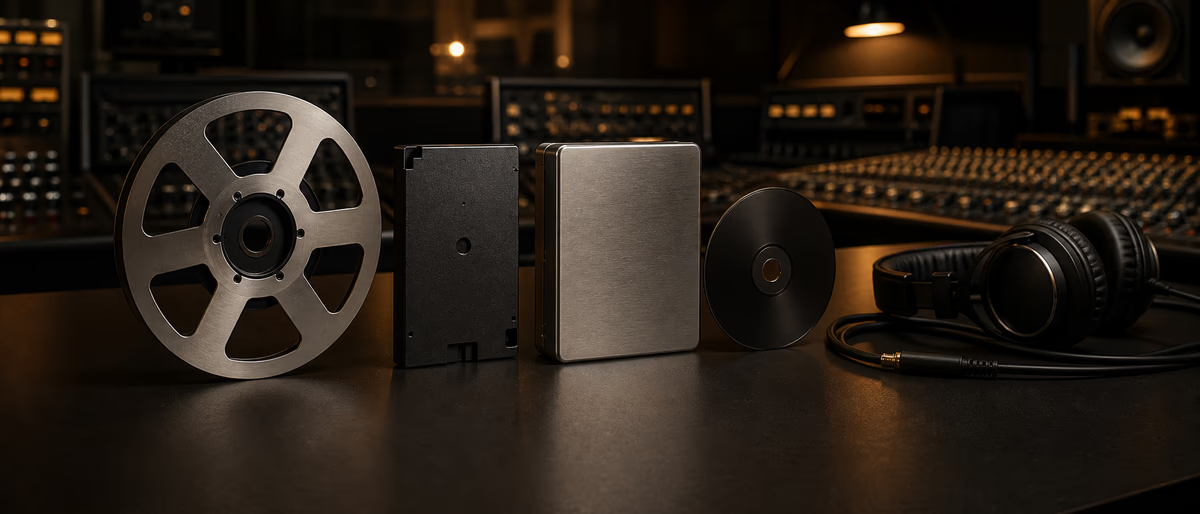
All four names show up in producer workflows, but they solve different problems. Uncompressed PCM in WAV and AIFF stores raw sample data. FLAC compresses that same PCM losslessly. MP3 throws away information permanently to shrink files for streaming and quick sharing.
| Format | Compression | Typical use | Best for |
|---|---|---|---|
| WAV | None (PCM) | Windows-heavy studios, beat delivery, stems | Default client delivery on most platforms |
| AIFF | None (PCM) | Logic/Ableton Mac workflows, legacy pro tools | Mac-centric collaborators and Apple ecosystem users |
| FLAC | Lossless | Archiving, distro uploads, large stem packs | Smaller files without sacrificing PCM quality |
| MP3 | Lossy | Email previews, tagged beat demos, references | Quick listening — not final paid deliverables |
- PCM Pulse-code modulation — uncompressed digital audio samples. WAV and AIFF both wrap PCM in different container structures.[1]
- Lossless FLAC reduces file size but decodes back to the original PCM bit-for-bit, verified by an MD5 checksum of the unencoded audio.[2]
- Lossy MP3 and similar codecs discard data you cannot recover. Fine for previews; risky as a sole master delivery.
WAV: The Default Producer Delivery Format
WAV (RIFF WAVE) is the format most beat marketplaces, mix engineers, and distributors expect. Microsoft defined the specification; McGill University's audio format documentation describes WAV as little-endian RIFF chunks containing PCM or other encoded data.[1]
For client work, export interleaved stereo PCM WAV at your session sample rate. If you mastered at 48 kHz, deliver 48 kHz — do not downsample unless the client explicitly requests it. Spotify accepts WAV delivery when it uses the WAVE_FORMAT_PCM format code with valid fmt and data subchunks.[3]
Bit depth and headroom
Use 24-bit WAV for mixes and masters when that is your native session depth. Spotify recommends delivering 24-bit audio when the native master is 24-bit, and 16-bit only when no higher-bit-depth master exists.[3] Leave modest headroom on the stereo bus — clipped masters force the next engineer to work around distortion that cannot be undone.
AIFF: When Mac Workflows Demand It
AIFF and AIFF-C come from Apple and use big-endian IFF chunks — the byte order is the main technical difference from WAV.[4] Modern DAWs on Mac read both formats interchangeably, but some legacy Logic or Pro Tools sessions and older collaborators still prefer .aif extensions.
AIFF supports PCM at any bit depth within a container rounded up to a multiple of 8 bits, with data left-justified and zero-padded.[4] In practice, if your client runs Logic on Mac and asks for AIFF, send AIFF. If they did not specify, WAV is the safer universal default.
FLAC: Lossless Compression for Big Deliveries
FLAC is ideal when you need PCM fidelity but want to email or upload a 500 MB stem pack without timing out. The Xiph.Org format stores metadata blocks plus encoded audio frames; decoders verify integrity against the original PCM via MD5.[2]
Spotify prefers FLAC for audio delivery and accepts WAV meeting the same technical requirements.[3] For beat leases and mixing clients, FLAC is less common than WAV but perfectly professional — include a note that files are lossless and can be converted to WAV in any DAW or with free tools like ffmpeg.
MP3: Previews Only, Not the Product
MP3 exists because file size matters for quick sharing. Tagged beat previews, Instagram snippets, and "check this idea" emails are legitimate MP3 use cases. The moment money changes hands for a lease, mix, or master, deliver uncompressed PCM.
Lossy codecs introduce encoding artifacts that accumulate if the artist re-encodes for streaming or bounces stems. Starting from WAV or FLAC keeps the production chain clean. If a client asks for MP3 because their phone storage is tight, explain the tradeoff and offer FLAC as a middle ground.
What to Send for Each Scenario
| Scenario | Recommended format | Notes |
|---|---|---|
| Beat lease (untagged) | 24-bit WAV | Include BPM and key in filename |
| Beat lease (tagged preview) | MP3 or streaming link | Full WAV unlocks after purchase |
| Mix delivery to artist | 24-bit WAV | Match session sample rate |
| Stem pack to mixer | 24-bit WAV per stem | All stems same length, bar 1 aligned |
| Master to distributor | 24-bit WAV or FLAC | Native bit depth; no pre-downsampling[3] |
| Reference mix for approval | MP3 or lossless | Label clearly as reference, not final |
- Confirm format before export
Ask the client or check the marketplace spec. BeatStars and most engineers default to WAV. - Export at session rate and depth
Do not downsample or reduce bit depth unless requested. Let distributors handle conversion.[3] - Name files professionally
Use Artist_SongTitle_Mix_24bit.wav — not final_FINAL_v4.wav. - Zip stems with a README
List BPM, key, sample rate, bit depth, and stem labels in a text file inside the zip. - Test the download
Open the exported files on a second machine or phone before sending the link.
Format Mistakes That Kill Professional Credibility
Sending a 128 kbps MP3 as a paid lease delivery — the artist cannot print that to streaming without audible quality loss.
Exporting WAV with WAVE_FORMAT_EXTENSIBLE when the recipient's pipeline expects standard PCM WAV — Spotify explicitly rejects extensible WAV for delivery.[3]
Stems at different sample rates or lengths — format correctness does not matter if files drift out of sync.
Upsampling a 16-bit session to 24-bit at export and calling it "hi-res" — you gain file size, not information.
Export cleaner mixes with free EQ, compression, and utility plugins from Plugg Supply.
Learning path
Related answer hubs
Related catalog
More tutorials from the catalog
More tutorials from the Plugg Supply feed, ranked by catalog popularity.
![Music Hackspace Synthesis with Max: Granular by Phelan Kane [TUTORiAL]](/images/posts/music-hackspace-synthesis-with-max-granular-by-phelan-kane-86602.avif?v=2026080101)
LEARNING / VIDEO TUTORIALS
Music Hackspace Synthesis with Max: Granular by Phelan Kane [TUTORiAL]
![True Sound Music Library INITIATION [TUTORiAL]](/images/posts/true-sound-music-library-initiation-85302.avif?v=2026080101)
LEARNING / VIDEO TUTORIALS
True Sound Music Library INITIATION [TUTORiAL]
![Tus Clases De Guitarra Tecnicas y Recursos [TUTORiAL]](/images/posts/tus-clases-de-guitarra-tecnicas-y-recursos-86551.avif?v=2026080101)
LEARNING / VIDEO TUTORIALS
Tus Clases De Guitarra Tecnicas y Recursos [TUTORiAL]
![789ten The DubVision Producer Pack v.6 [WAV, MiDi, Synth Presets, TUTORiAL]](/images/posts/789ten-the-dubvision-producer-pack-v6-86546.avif?v=2026080101)
Samples / Presets / MIDI / VIDEO TUTORIALS
789ten The DubVision Producer Pack v.6 [WAV, MiDi, Synth Presets, TUTORiAL]
Related articles
LEARNING / VIDEO TUTORIALS
Music Hackspace Synthesis with Max: Granular by Phelan Kane [TUTORiAL]
LEARNING / VIDEO TUTORIALS
True Sound Music Library INITIATION [TUTORiAL]
LEARNING / VIDEO TUTORIALS
Tus Clases De Guitarra Tecnicas y Recursos [TUTORiAL]
Samples / Presets / MIDI / VIDEO TUTORIALS
789ten The DubVision Producer Pack v.6 [WAV, MiDi, Synth Presets, TUTORiAL]
![Truefire Melodic Trevor Gordon Hall's Melodic Picking Practice Plan (JamPlay) [TUTORiAL]](/images/posts/truefire-melodic-trevor-gordon-halls-melodic-picking-practic-86171.avif?v=2026080101)
LEARNING / VIDEO TUTORIALS
Truefire Melodic Trevor Gordon Hall's Melodic Picking Practice Plan (JamPlay) [TUTORiAL]
![Udemy Beginner Acoustic Guitar Chords, Strumming And Fingerpicking [TUTORiAL]](/images/posts/udemy-beginner-acoustic-guitar-chords-strumming-and-fingerpi-86552.avif?v=2026080101)
LEARNING / VIDEO TUTORIALS
Udemy Beginner Acoustic Guitar Chords, Strumming And Fingerpicking [TUTORiAL]
Frequently Asked Questions
- Should I deliver WAV or MP3 to a beat leasing client?
- Deliver 24-bit WAV for paid leases. MP3 is fine for tagged previews and free type-beat streams, but paying clients need uncompressed PCM they can record over and release.
- What is the difference between WAV and AIFF?
- Both store uncompressed PCM audio. WAV uses little-endian RIFF chunks (Microsoft spec); AIFF uses big-endian IFF chunks (Apple spec).[1][4] Modern DAWs read both; WAV…
- Is FLAC as good as WAV for mixing?
- Yes. FLAC is lossless — it decodes to identical PCM, verified by an MD5 checksum of the original audio.[2] Some older workflows prefer WAV for simplicity.
- What sample rate should I use for client delivery?
- Export at your session sample rate. Spotify accepts 44.1 kHz or higher and handles downsampling internally — do not pre-downsample before delivery.[3]
- Should I deliver 16-bit or 24-bit WAV?
- Deliver 24-bit if your session and master are 24-bit. Use 16-bit only when that is the native master depth — Spotify asks for the highest available native bit depth.[3]
- Can I send FLAC to Spotify through a distributor?
- Spotify prefers FLAC for delivery and also accepts compliant WAV files. Deliver one high-quality stereo master per track at native resolution.[3]
- Why do my WAV files get rejected by some upload portals?
- Some platforms reject WAV files using WAVE_FORMAT_EXTENSIBLE instead of standard PCM (0x0001). Re-export as standard PCM WAV if uploads fail.[3]