
What Makes an EDM Sample Pack Complete?
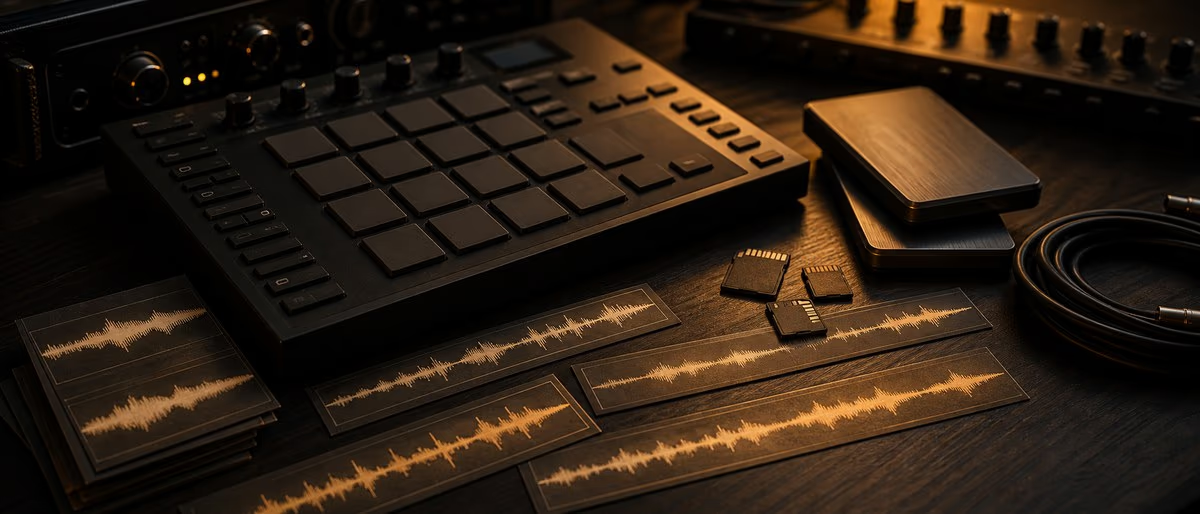
EDM production relies on high-energy loops and one-shots designed for maximum impact on large sound systems. A quality EDM pack includes: full drum kits, FX (rises, impacts, sweeps), synth loops, and MIDI patterns.
EDM is structured around tension and release. Packs should include build-up elements (rises, white noise sweeps, pitch-bending leads) and drop elements (punchy drums, basslines, vocal chops) to create the genre's characteristic dynamics.
Dubstep: Wobbles, Bass Drops, and Mid-Range growl
Dubstep packs need heavy bass design: wobbly Reese bass, aggressive growls, and mid-range synth stabs. Look for: processed 808s, distorted bass stabs, glitched vocal samples, and impact FX.
Dubstep BPM: 140–142. Key production techniques: sidechain compression to the kick, high-pass filtering bass sounds to leave room for the sub, and OTT compression for supersaw leads.
Big Room House: Ultra-Clean Drums and Euphoric Builds
Big room house prioritizes simplicity and impact. Kick-heavy drum patterns, wide supersaw leads, and minimal percussion. The drop hits harder because the arrangement stays sparse.
Big room BPM: 126–132. Look for: pristine 909/maimbo drum samples, reverb-drenched snare rolls, wide stereo leads, and uplifter/scratch FX for buildups.
Future Bass: Layered Pads, Chopped Vocals, and Flips
Future bass layers lush chord pads, heavily-processed vocal chops, and bright plucks. The signature sound: supersaw chords combined with pitched vocal samples and trap-style hi-hats.
Future bass BPM: 140–175 (often half-time feel). Production hallmarks: bright mix with high frequencies accentuated, sidechain pumping, chopped vocal one-shots, and supersaw chords in minor keys.
EDM Sub-Genre Sample Pack Requirements
| Genre | BPM | Essential Elements | Top Sources |
|---|---|---|---|
| Dubstep | 140–142 | Wobble bass, growl synths, impact FX, glitched vocals | Black Box, IDJ, Vengeance |
| Big Room House | 126–132 | Punchy kicks, supersaw leads, riser FX, vocal shouts | Spinnin' Records, EDM Academy, Cymatics |
| Future Bass | 140–175 | Chord pads, vocal chops, bright plucks, trap hats | Future Fox, Noiseporn, Veters |
| Drum & Bass | 170–180 | Breaky drums, reese bass, atmospheric pads, amen breaks | Industrial Strength, Goldbatch, Ray Rosa |
| Trapstep | 140 | 808s, Trap hats, growly bass, dubstep wobbles | Heavy, Bunney, Sick Drums |
Build an EDM Drop in 5 Steps
- 1. Select and Process Your Kick Choose a punchy, sub-heavy kick that cuts through on club systems. Layer with a click transient (10ms noise burst) for attack. Apply subtle saturation to add harmonic content above 100 Hz.
- 2. Create a Signature Bass Pattern Design a Reese or growl bass using subtractive or wavetable synthesis. Process with distortion (FabFilter Saturn, decapitator) and OTT compression for width and density. Sidechain to the kick for pumping.
- 3. Layer Synth Stabs and Leads Add 2–3 synth layers: a wide supersaw chord, a mid-range stab for punch, and a high arpeggio for brightness. Pan the stab and arpeggio slightly left/right. Leave the supersaw center.
- 4. Add Rhythmic Percussion Program a hi-hat pattern with closed hats on 8ths and open hats on the and-of-2 and and-of-4. Add a shaker or tambourine loop for groove. Automate a high-pass filter on percussion during the build-up.
- 5. Add FX: Riser, Impact, and Automation Place a riser (white noise sweeping up in pitch) for 4–8 bars before the drop. End the build with an impact (sub-boom or white noise crash). Automate the master low-pass filter to open on the first beat of the drop.
Learning path
Related answer hubs
Genre feed
EDM materials from the feed
Loops, one-shots, presets and catalog drops that match the EDM production lane.
![Industrial Strength Records Weird Little One Shots [WAV, Synth Presets]](/images/posts/industrial-strength-records-weird-little-one-shots-81998.avif?v=2026080101)
![Native Instruments Session Guitarist Electric Neon Deluxe v1.0.0 [KONTAKT]](/images/posts/native-instruments-session-guitarist-electric-neon-deluxe-85519.avif?v=2026080101)
![Black Octopus Sound UWU Gamer Girl Vocals [WAV]](/images/posts/black-octopus-sound-uwu-gamer-girl-vocals-83456.avif?v=2026080101)
![Basic Wavez FX Mega Pack Vol.1 [WAV]](/images/posts/basic-wavez-fx-mega-pack-vol1-84045.avif?v=2026080101)
Related articles
![Richards Angelcore Drum Kit + Preset [WAV, MiDi, Synth Presets]](/images/posts/richards-angelcore-drum-kit-preset-81534.avif?v=2026080101)
Samples / Presets / MIDI
HotRichards Angelcore Drum Kit + Preset [WAV, MiDi, Synth Presets]
![Multiply Sound CHPTRS Film Score Collection [WAV]](/images/posts/multiply-sound-chptrs-film-score-collection-81682.avif?v=2026080101)
![Loopmasters The Cube Guys Twisted House and Tribal Tech [MULTiFORMAT]](/images/posts/loopmasters-the-cube-guys-twisted-house-and-tribal-tech-86677.avif?v=2026080101)
![DECAP Knock Audio Drums That Knock 11 [WAV]](/images/posts/decap-knock-audio-drums-that-knock-11-83936.avif?v=2026080101)
![Collab Gem Late Night Breakbeat [WAV, MiDi]](/images/posts/collab-gem-late-night-breakbeat-70409.avif?v=2026080101)
![VOX Neith: Ambient Vocal Electronica [WAV]](/images/posts/vox-neith-ambient-vocal-electronica-74339.avif?v=2026080101)
Looking for festival-ready one-shots, loops, and MIDI?
Browse Free DownloadsEDM Sample Packs: Common Questions
- What's the best free EDM sample pack?
- Cymatics offers quality free starter packs for most EDM sub-genres. LANDR Free Sample Pack program provides professionally curated loops. Splice has a free monthly pack rotating across genres. Vandalism's free section is also worth checking for drums and FX.
- Can I sell tracks made with EDM sample packs?
- Yes — with royalty-free licenses from Splice, LANDR, Vengeance, or Vandalism, you retain full commercial rights to your tracks. Some pack-specific licenses require attribution or restrict synchronous use (e.g., compilations). Always verify the license before release.
- What DAW do most EDM producers use?
- Ableton Live is the most popular EDM DAW for its Session View workflow and built-in audio-to-MIDI capabilities. FL Studio is dominant for trap, future bass, and hip-hop-influenced EDM. Logic Pro is popular for composers who need strong stock plugins. All three can produce professional EDM.
- How do I make my EDM mix sound loud and clean like professional releases?
- Use bus compression (slow attack, 2–4:1 ratio) on drums and bass subgroups. Apply clip gain staging to prevent digital overs. Use a limiter on the master with 1–3 dB of gain reduction for loudness. Reference your mix against a commercially released track at the same genre BPM.
- What are the best riser and FX samples for EDM builds?
- Look for: pitch-rising white noise sweeps (4-bar, 8-bar, 16-bar lengths), reverse reverb crashes, tape stop effects, vinyl brake FX, and dubbed-out filter sweeps. Layer multiple FX elements and automate them in layers to create unique, multi-layered build-ups.