
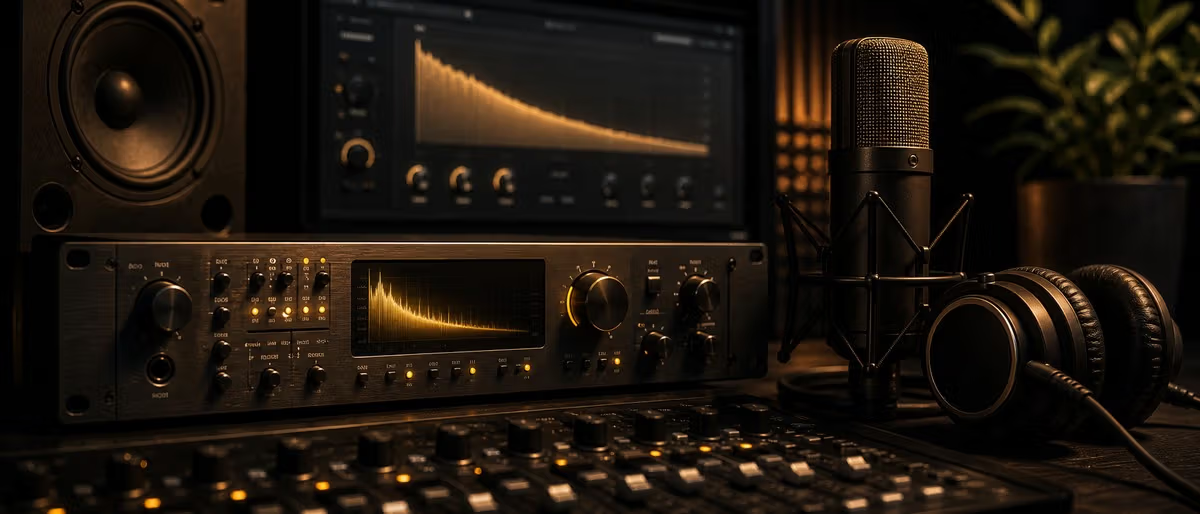
The best free reverb VST plugins in 2026 are Valhalla Supermassive, OrilRiver, Dragonfly Reverb, TAL-Reverb-4, and Cloudseed. All five run on Windows and macOS, work in FL Studio, Ableton Live, and Logic Pro, and cover every reverb type from tight rooms to infinite shimmer.
Free reverb plugins have reached professional quality. Valhalla Supermassive is used on major-label releases. OrilRiver ships with more parameters than many paid alternatives. The gap between free and paid reverb has essentially closed for the vast majority of production workflows.
What Makes a Good Reverb Plugin?
When evaluating a free reverb plugin, four technical factors determine whether it belongs in a professional mix:
- Diffusion algorithm quality — look for smooth exponential decay without metallic flutter or patterned echoes in the tail. Poor diffusion reveals itself on sustained piano chords and held vocal notes.
- CPU efficiency — reverb is notoriously expensive. A plugin that consumes more than 3–5% CPU per instance will limit how many you can run simultaneously in dense arrangements.
- Pre-delay control — the ability to offset the wet signal by 10–40 ms is essential for keeping dry sources intelligible in dense mixes. Any reverb without pre-delay control is a studio compromise.
- DAW format compatibility — verify VST3 for FL Studio and Ableton Live, AU for Logic Pro, and AAX for Pro Tools. Most modern free reverbs ship as VST3 and AU simultaneously.
- Modulation depth — subtle chorus-like modulation on the tail prevents static, metallic artifacts and adds organic movement. Adjustable modulation rate and depth separate professional reverbs from basic ones.
Top 10 Free Reverb VST Plugins 2026
| Plugin | Type | Best For | Platform | CPU Usage |
|---|---|---|---|---|
| Valhalla Supermassive | Algorithmic | Pads, ambient, shimmer | Win / Mac | Low |
| OrilRiver | Algorithmic | Drums, vocals, general mix | Win / Mac | Low |
| Dragonfly Reverb | Algorithmic | Room and hall simulation | Win / Mac / Linux | Low |
| TAL-Reverb-4 | Algorithmic | Vintage plates, synths | Win / Mac | Low |
| Cloudseed | Algorithmic | Infinite tails, sound design | Win only | Medium |
| Convology XT | Convolution | Real room impulse responses | Win / Mac | Medium |
| MConvolutionEZ | Convolution | Studio and hardware emulation | Win / Mac | Medium |
| Sanity Audio Tools Verb | Algorithmic | Hip-hop and trap vocals | Win / Mac | Low |
| Freeverb3 VST | Algorithmic | Transparent room ambience | Win / Mac | Low |
| Fog Convolver | Convolution | Custom IRs and creative use | Win / Mac | High |
Top 5 Free Reverb Plugins: Detailed Reviews
Valhalla Supermassive
Free Algorithmic Reverb / DelayReleased by ValhallaDSP as permanent freeware, Supermassive has been downloaded over a million times and appears on commercially released albums across ambient, electronic, and cinematic genres. Its 24 named modes each use a distinct feedback network topology — not variations of one algorithm. Pre-delay goes to 100 ms, modulation rate and depth are independent per mode, and the mix parameter works on a dry-wet basis suitable for both insert and send use. Available as VST3 and AU; fully supported in FL Studio, Ableton Live, Logic Pro, Reaper, Cubase, and Pro Tools.
Zero cost permanently from the developer; 24 distinct modes covering rooms to infinite shimmer; modulation controls prevent metallic tails; very low CPU load.
No convolution mode; no built-in wet EQ (add a post-reverb EQ); no dedicated early reflections control.
OrilRiver
Free Stereo Algorithmic ReverbOrilRiver by Denis Tihanov is the most parametrically complete free reverb available. It exposes controls most paid plugins hide: early reflections level and time, three-band EQ on the wet signal, separate stereo width for early reflections and late reverb, and HF damping simulating air absorption. This level of control makes it a direct replacement for paid algorithmic reverbs in mixing contexts. Available as a 32-bit and 64-bit VST for Windows; macOS users need a VST wrapper or an AU port.
Three-band wet EQ built in; separate early reflections and late reverb controls; stereo width per component; free with no registration.
Windows VST only from the developer (no native AU); 32-bit version may need a bridge in modern DAWs; non-scaling UI on high-DPI displays.
Dragonfly Reverb
Free Open-Source Reverb SuiteDragonfly is four separate plugins: Room, Hall, Plate, and Early Reflections. Each uses a distinct core algorithm — Room on a Freeverb-derived network, Hall on a Sean Costello late-reverb algorithm, Plate emulating the EMT 140 topology, and Early Reflections isolating the pre-reverb reflection pattern. Cross-platform across Windows, macOS, and Linux in VST, VST3, AU, and LV2 formats. Source code is maintained on GitHub.
Four algorithms covering every reverb type; Linux LV2 support; open-source with ongoing maintenance; very low CPU footprint.
Hall algorithm lacks density on very long decay settings; no modulation on the Room variant; minimal UI.
TAL-Reverb-4
Free Vintage Plate ReverbTAL Software's Reverb-4 models classic hardware plate reverb units, producing the dense smooth tails associated with 1980s recordings. The interface is minimal — decay, pre-delay, low-cut, high-cut, and mix. The algorithm handles diffusion automatically in a way that sounds musical without tweaking. Runs as VST, VST3, and AU on Windows and macOS. TAL also offers a free VST2 version for legacy hosts.
Vintage plate character out of the box; simple interface for fast mix decisions; VST and AU for all major DAWs; low CPU.
No modulation or shimmer modes; no early reflections control; single algorithm limits versatility for modern sound design.
Cloudseed
Free Algorithmic Reverb (Windows)Cloudseed by Nils Jonas Norberg uses a dense feedback delay network with modulated allpass filters, producing smooth evolving tails with far more complexity than typical free options. It offers separate decay times for low and high frequencies, modulation rate and amount, diffusion stages, and a pre-delay up to 500 ms — longer than any competitor in this list. Suited to sound design, ambient production, and cinematic scoring. Windows VST only.
Exceptional tail smoothness; separate low/high decay rates; 500 ms pre-delay for dramatic placement; unique character for ambient and cinematic work.
Windows VST only — no macOS, no AU, no VST3; non-resizable UI; no preset browser; moderately higher CPU than simpler options.
How to Use Reverb in Your Mix
- Use send channels, not inserts, for shared reverb. Create one or two reverb return tracks and route multiple channels via send knobs. This uses one CPU instance instead of five and ensures mix cohesion — all instruments share the same acoustic space.
- High-pass the reverb return at 100–200 Hz. Low-frequency reverb energy creates mud, especially under kick and bass. Apply a high-pass EQ on the return track. For hall reverbs on vocals, 200 Hz is a practical starting point.
- Set pre-delay based on tempo. A pre-delay equal to one 16th note (at 90 BPM: 166 ms ÷ 4 = 41 ms) keeps the dry transient intelligible before the tail appears. Use a BPM-to-ms calculator or a tempo-synced pre-delay if the plugin supports it.
- Match decay time to song tempo. At 140 BPM trap tempo, a decay of 0.8–1.2 seconds on snare reverb keeps the groove punchy. Longer decays suit slower sections or dedicated ambient layers.
- Use different reverb types for different sources. Plate reverb suits vocals and snares (dense, tight, musical). Hall reverb suits strings and pads (spacious, diffuse). Room reverb suits drums and guitars (natural, proportional). Shimmer reverb suits lead synths (ethereal, pitched).
- Automate the send level for dynamics. Pulling the reverb send down in chorus and up in verse makes a track breathe. Alternatively, sidechain the reverb return to the kick drum for a pumping effect common in house and techno.
- Layer two reverbs — short and long. A short room reverb (0.3–0.5 s) adds presence; a long hall or plate (1.5–3 s) adds emotion. Blend at roughly 70% short and 30% long for most vocal and lead instrument applications.
Reverb Types Explained
Hall
Simulates large concert halls. Long pre-delay, diffuse tail, 2–5 second decay. Used on strings, pads, and orchestral instruments.
Room
Simulates small to medium enclosed spaces. Short decay (0.2–0.8 s), pronounced early reflections. The most natural-sounding type for drums and guitars.
Plate
Emulates the EMT 140 hardware plate reverb. Dense, smooth tail with fast buildup. The standard for vocals and snares since the 1970s.
Spring
Emulates a spring tank reverb unit as found in guitar amplifiers. Metallic, bouncy character. Used in dub, reggae, surf, and lo-fi genres.
Shimmer
Algorithmic reverb with pitch-shifted feedback — typically an octave up. Produces ethereal, evolving pads from any input. Made famous by Brian Eno and Daniel Lanois in the 1980s.
Convolution
Uses recorded impulse responses of real acoustic spaces or hardware units. Acoustically precise but more CPU-intensive than algorithmic types.
Browse free reverb plugins, synthesizers, and mixing effects — all verified and delivered instantly via Telegram.
Browse Free DownloadsFrequently Asked Questions
- What is the best free reverb VST plugin in 2026?
- Valhalla Supermassive is the most widely used free reverb plugin in 2026. It covers 24 distinct reverb and delay modes from room ambience to infinite shimmer tails, runs on low CPU, and is available free from ValhallaDSP for Windows and macOS.
- Does Valhalla Supermassive work in FL Studio and Ableton Live?
- Yes. Valhalla Supermassive ships as a VST3 for Windows and macOS and as an AU for macOS. It is fully compatible with FL Studio, Ableton Live, Logic Pro, Reaper, Cubase, and Studio One.
- What is the difference between algorithmic and convolution reverb?
- Algorithmic reverb generates reverberation mathematically using delay networks and feedback loops. Convolution reverb uses recorded impulse responses of real spaces or hardware and convolves them with your audio. Algorithmic reverbs are lower CPU and more flexible; convolution reverbs are more acoustically realistic.
- Should I use reverb on the insert or a send track?
- Use a send (auxiliary) track in nearly all cases. Place the reverb on a return track and route multiple channels via send knobs. This uses one CPU instance instead of many, ensures all sources share the same acoustic space, and lets you process the entire wet signal with one EQ.
- Why does my mix sound muddy when I add reverb?
- Muddy reverb is caused by low-frequency energy in the wet signal. High-pass the reverb return at 100–200 Hz to fix it. Also add 20–40 ms of pre-delay to create separation between the dry transient and the reverb tail.
- Are free reverb plugins good enough for professional mixing?
- Yes. Valhalla Supermassive, OrilRiver, and Dragonfly Reverb are used in professional and commercial productions. The free reverb category reached professional quality around 2018 and the gap to paid options like Lexicon and Valhalla Room is marginal for most genre contexts.