
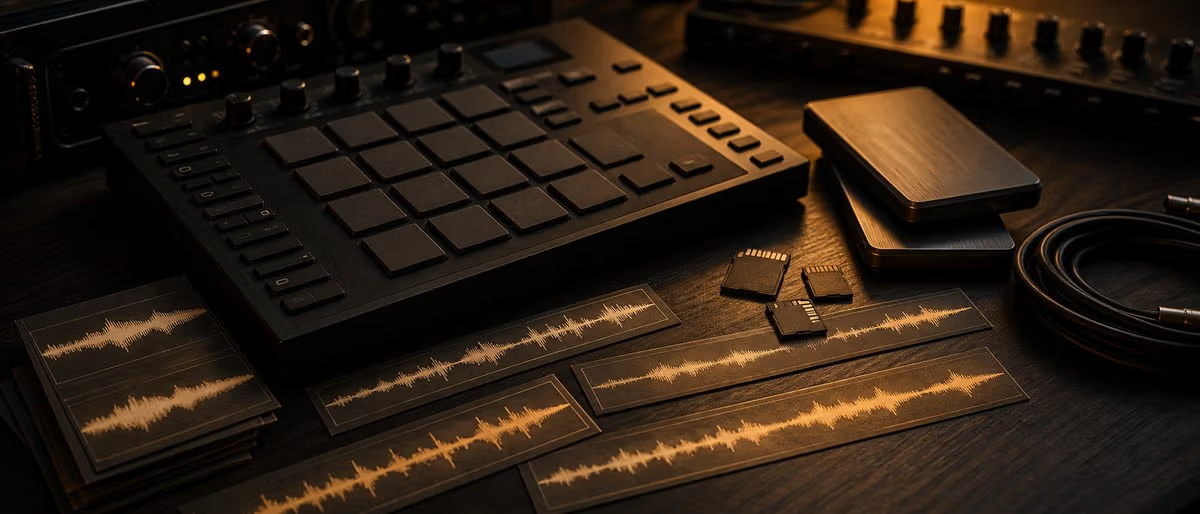
Free sample packs
Quick answer: The best free sample packs are clearly licensed royalty-free WAV kits: drum one-shots, 808s, melodic loops, and FX from sources like Plugg Supply, label free drops, and CC0/community libraries when terms allow commercial use. Prefer 24-bit WAV with genre, BPM, and key metadata.
Free sample pack selection choose packs by license clarity, WAV quality, and genre-matched sound types—not by ZIP size alone. Producer workflows prioritize one-shots, 808s, and licensed melodic material for release-safe beats. Best free sample packs .
Quick Answer
The best free sample packs are royalty-free WAV kits with clear licenses—drum one-shots, 808s, melodic loops, and FX. Start with genre-matched free packs on Plugg Supply, then add Looperman or CC0 and label freebies when commercial terms are explicit. Prefer 24-bit WAV with genre, BPM, and key labels.
Learning path
Related answer hubs
Free Sample Packs Free sample packs: how to choose safe, useful sounds for real productions. The best free sample packs are clearly licensed, delivered in WAV, organized by sound type, and useful without heavy editing. Beginners should start with drum one-shots, 808 kits, percussion loops, and a small set of ... Sound Design Sound design: synthesis basics, bass design, presets, and usable sounds. Sound design is the process of creating or reshaping sounds with oscillators, samples, filters, envelopes, LFOs, effects, and layering. Beginners should learn one synth, build simple basses, leads, pads, and plucks, t... Music Production for Beginners Music production for beginners: a simple roadmap from first DAW to finished beat. A beginner music producer should pick one DAW, learn basic MIDI and drum programming, use a small set of free plugins and samples, finish a short beat, export it, and repeat the process weekly. Finishing tracks is mor...
Related articles
![789ten The DubVision Producer Pack v.6 [WAV, MiDi, Synth Presets, TUTORiAL]](/images/posts/789ten-the-dubvision-producer-pack-v6-86546.avif?v=2026080101)
New
Subscription
Samples / Presets / MIDI / VIDEO TUTORIALS
789ten The DubVision Producer Pack v.6 [WAV, MiDi, Synth Presets, TUTORiAL]
![Tus Clases De Guitarra Tecnicas y Recursos [TUTORiAL]](/images/posts/tus-clases-de-guitarra-tecnicas-y-recursos-86551.avif?v=2026080101)
New
Subscription
LEARNING / VIDEO TUTORIALS
Tus Clases De Guitarra Tecnicas y Recursos [TUTORiAL]
![Music Hackspace Synthesis with Max: FM by Ned Rush [TUTORiAL]](/images/posts/music-hackspace-synthesis-with-max-fm-by-ned-rush-86583.avif?v=2026080101)
New
24h Subscription
LEARNING / VIDEO TUTORIALS
Music Hackspace Synthesis with Max: FM by Ned Rush [TUTORiAL]
![Truefire Melodic Trevor Gordon Hall's Melodic Picking Practice Plan (JamPlay) [TUTORiAL]](/images/posts/truefire-melodic-trevor-gordon-halls-melodic-picking-practic-86171.avif?v=2026080101)
New
Subscription
LEARNING / VIDEO TUTORIALS
Truefire Melodic Trevor Gordon Hall's Melodic Picking Practice Plan (JamPlay) [TUTORiAL]
![MixWithTheMasters WILDCHILD Alex Warren Inside the Track #172 [TUTORiAL]](/images/posts/mixwiththemasters-wildchild-alex-warren-inside-the-track-172-86569.avif?v=2026080101)
New
Subscription
LEARNING / VIDEO TUTORIALS
MixWithTheMasters WILDCHILD Alex Warren Inside the Track #172 [TUTORiAL]
![Truefire Rhythm Guitarist Fretboard Roadmap (JamPlay) [TUTORiAL]](/images/posts/truefire-rhythm-guitarist-fretboard-roadmap-jamplay-86194.avif?v=2026080101)
New
Subscription
LEARNING / VIDEO TUTORIALS