Music Production Equipment Guide: MIDI, Monitors, Microphones (2026)

Complete guide to home studio gear. MIDI keyboards, studio monitors, microphones, audio interfaces and MPC controllers — what you really need.

Music Production Equipment Guide: MIDI, Monitors, Microphones (2026)

Music Production Equipment Guide (2026)

A professional-sounding home studio does not require expensive hardware. The DAW, audio interface, and monitoring chain matter far more than the room you work in — especially when working at the mix-and-sample level. This guide covers what to buy at each stage of your production journey, with specific model recommendations verified for 2026.

Studio Setup by Budget

Starter (Under €200)

  • DAW: GarageBand (free, macOS/iOS), LMMS (free, all platforms), or Reaper ($60 discounted licence)
  • Headphones: Audio-Technica ATH-M20x (~€50) or Sony MDR-7506 (~€90) — both deliver flat monitoring response
  • MIDI controller: Arturia MiniLab MkII 25-key (~€60) for note input and macro control
  • Samples & presets: Plugg Supply (free), Splice free plan (100 credits/month), Looperman

Intermediate (€200–€800)

  • DAW: Ableton Live Intro (€99), FL Studio Producer (€199), or Logic Pro (€229.99 on Mac)
  • Audio interface: Focusrite Scarlett 2i2 4th gen (~€180) — 56 dB preamp gain, USB-C, under-5ms latency
  • MIDI keyboard: Arturia KeyLab Essential 49 MkIII (~€200) — includes Analog Lab V plug-in
  • Studio monitors: Yamaha HS5 pair (~€400) or KRK Rokit 5 G4 pair (~€350)
  • Condenser mic: Audio-Technica AT2020 (~€99) or Rode NT1 5th gen (~€179)

Advanced (€800+)

  • DAW + plugins: Ableton Live Suite (€749) + third-party instruments (Serum €189, Omnisphere 2 €499)
  • Audio interface: Universal Audio Apollo Twin X (~€899) — onboard Unison preamps, real-time UAD processing
  • Weighted keyboard: Native Instruments Komplete Kontrol S61 MkII (~€699) or Roland A-88 MkII (~€799)
  • Monitors: Yamaha HS8 pair (~€700) or Genelec 8030C pair (~€900)
  • Acoustic treatment: GIK Acoustics panels (bass traps + broadband absorbers) — minimum 8 panels for a 10 m² room

Core Equipment Explained

  • DAW (Digital Audio Workstation) — The central hub of all production. Ableton Live: industry standard for electronic music and live performance. FL Studio: dominant in hip-hop and trap. Logic Pro: Apple-optimised, comprehensive stock plug-ins. Pro Tools: recording studio standard, required for professional mixing/mastering work.
  • Audio Interface — Converts analogue signals (microphone, guitar, keyboard) to digital audio your computer can process. Key specs: preamp quality (measured in EIN noise: lower is better), AD/DA conversion bit depth (24-bit minimum), and round-trip latency (target <10 ms at 64-sample buffer). Focusrite Scarlett series is the most widely deployed beginner interface.
  • Studio Monitors — Near-field monitors with flat frequency response reveal mix problems that consumer speakers hide. Position them in an equilateral triangle with your mix position, tweeters at ear height. The Yamaha HS series uses a white woofer cone as a sonic reference marker matching Yamaha's NS10 legacy.
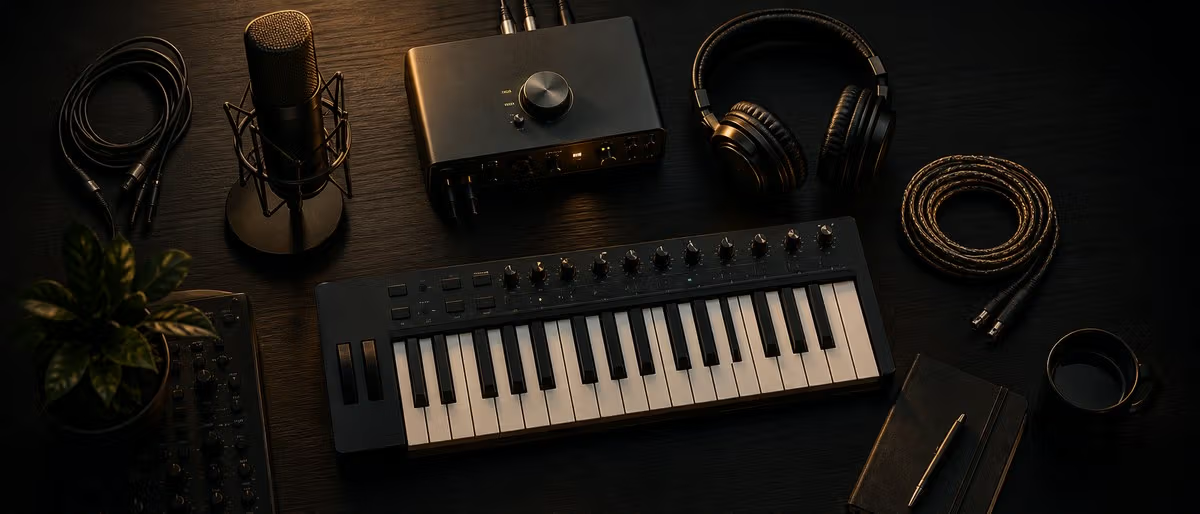
  • MIDI Controller — Hardware input for playing virtual instruments and programming sequences. 25-key controllers (Arturia MiniLab) suit beatmaking. 49–61 keys (KeyLab Essential) accommodate chord play. 88 weighted keys (Komplete Kontrol S88) replicate acoustic piano feel for classical and jazz production.
  • Headphones — Closed-back headphones (Sony MDR-7506, Beyerdynamic DT 770 Pro) isolate environmental noise for tracking and late-night mixing. Open-back headphones (Sennheiser HD 600, Beyerdynamic DT 990 Pro) offer a wider stereo image suitable for mixing when monitors are unavailable.
  • Microphone — Large-diaphragm condenser mics (AT2020, Rode NT1) capture vocals and acoustic instruments with detail and presence. For heavily treated rooms, a small-diaphragm condenser (Rode NT5) offers more accurate transient response. Dynamic mics (Shure SM7B at €449) are preferred for voiced podcasting and untreated room recording.

Learning path

Related answer hubs

Pair your setup with free professional sample packs and VST presets from Plugg Supply.

Browse Free Downloads

Frequently Asked Questions

Do I need acoustic treatment to make professional music?
Not initially. Headphone-based mixing with reference tracks from multiple systems (car speakers, earphones, laptop speakers) compensates for room problems at the early learning stage. Acoustic treatment becomes critical when you are mixing on monitors and need consistent, accurate low-frequency response below 200 Hz.
Audio interface vs. built-in sound card — what's the difference?
Consumer sound cards have high-latency drivers (20–50 ms typical), limited dynamic range (~100 dB), and no balanced XLR inputs. Audio interfaces provide ASIO/Core Audio low-latency drivers (2–10 ms), 24-bit/192 kHz conversion, and phantom-powered XLR inputs for condenser microphones.
What monitors should I use if I live in an apartment?
5-inch woofer monitors (Yamaha HS5, KRK Rokit 5) are practical for small untreated rooms — their low-frequency extension rolls off around 60 Hz, reducing interaction with room modes. For very small spaces, consider switching to closed-back headphones (Sony MDR-7506) as the primary mix tool and checking on monitors only briefly.
Which DAW is best for beginners in 2026?
GarageBand is unbeatable for Mac users: free, ships pre-installed, and upgrades directly to Logic Pro. On Windows, FL Studio has the lowest learning curve for beat-making and includes lifetime free updates — once purchased, all future versions are included. Ableton Live is the professional standard for electronic and live performance but has a steeper initial curve.
Is it possible to make professional music on a phone or tablet?
Yes for demos, sketches, and lo-fi production. GarageBand iOS, FL Studio Mobile, and BandLab are capable tools. For commercially distributed, professionally mixed releases, a laptop or desktop DAW provides the processing power, screen real estate, and plug-in ecosystem needed for polished results.