
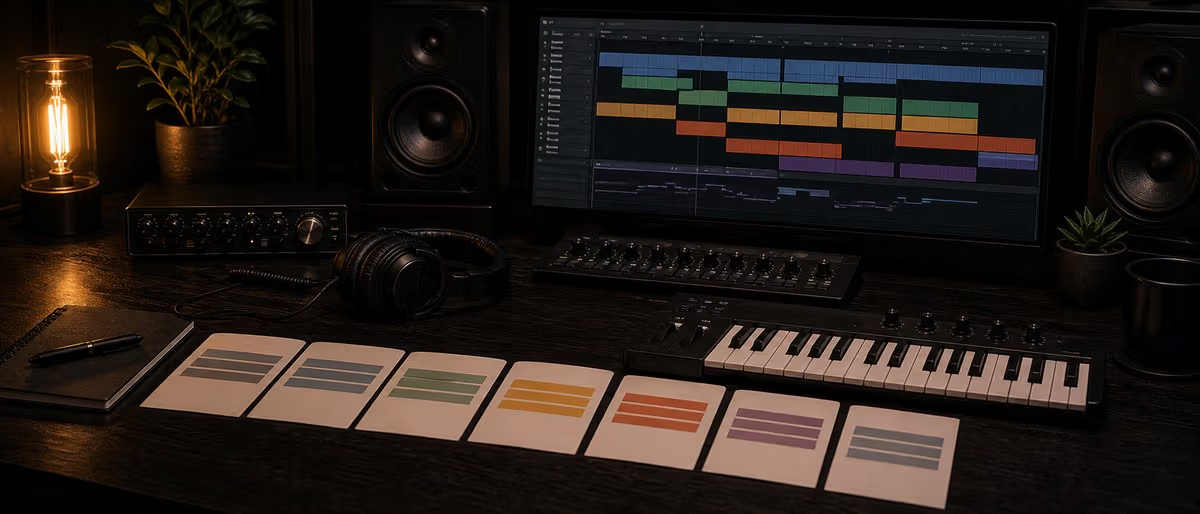
What Is Song Arrangement?
The Standard Pop/EDM Structure: Verse, Pre-Chorus, Chorus, Bridge, Outro
Hip-Hop and Trap Arrangement: Minimal Intro, Hard-Hitting Hooks, and Outro
House and Electronic Music Arrangement: The Build/Drop Framework
How Long Should Each Section Be? Bar Counts by Genre
Energy Management: How to Build Tension and Release Through Arrangement
Arrangement View vs. Pattern View: Working Efficiently in Your DAW
Arrangement Patterns by Genre
| Genre | Typical Structure | Layering Approach | Track Length | Outro Style |
|---|---|---|---|---|
| Hip-Hop/Trap | 16-bar intro, 16-bar verse, 8-bar hook/chorus | Minimal layering per section | 3:00-3:30 | Drop/outro kills energy |
| Pop | 8-bar intro, 16-bar verse, 8-bar pre-chorus, 8-bar chorus, 8-bar bridge | Heavy chorus, reduced bridge | 3:30-4:00 | Outro resolves fully |
| House/EDM | 16-bar intro, 16-bar build, 16-bar drop, 16-bar breakdown, 8-bar drop 2 | Drop-focused, minimal breakdown | 4:00-6:00 | Breakdown rebuilds into second drop |
| Lo-Fi Hip Hop | 8-bar loop, continuous variation | Low energy floor, subtle additions | 2:30-3:30 | Loop-based, gradual fade |
| R&B | 8-bar intro, 16-bar verse, 8-bar chorus, 16-bar verse 2, 8-bar bridge/chorus | Vocal-driven, long verses | 3:30-4:30 | Varies by subgenre |
Build an Arrangement in 8 Steps
- Start with your strongest 4 or 8-bar loop — this will be your chorus or drop: 1 Identify the loop that makes the track feel most alive — the one with all layers firing together — and use it as your energy reference point. Everything before and after it should be simpler by comparison.
- Build an intro: strip the loop to its bare essentials: 2 Remove melodic layers and keep only drums and bass, or even drums alone. An intro of 8 to 16 bars gives listeners time to settle into the groove before the full track arrives.
- Add a verse: reintroduce elements one by one: 3 Start with the kick and hi-hat, add the bass, then a lead synth or sample. Each element you add increases energy slightly. The verse should feel purposeful but not compete with the chorus.
- Create contrast: your verse should be deliberately simpler than your chorus: 4 Contrast is what makes each section land. If every section sounds identical in density and energy, the track has no journey. The verse exists to set up the chorus — without that setup, the chorus loses its impact.
- Place your chorus: 8 to 16 bars of the full loop with all elements: 5 This is the most energetic section of your track. Every layer you built in your reference loop should be present here. Do not hold back on your chorus — it is what listeners remember.
- Add a second verse: repeat verse structure but add one new element: 6 Add one new layer — a vocal ad-lib sample, an extra percussion piece, a different hi-hat pattern, or a background texture — to signal progression without disrupting the established groove.
- Bridge or breakdown: strip back the energy before the final chorus: 7 Remove two or three layers to create a dip in energy. This section gives the listener a moment of relief before the final chorus lands.
- Close with an outro: gradually remove elements or automate for a clean ending: 8 Either strip elements one by one (reverse of the intro approach) or automate volume and filter to close the track smoothly. Trap tracks often end abruptly on the final hook.
Learning path
Related answer hubs
Music Production for Beginners Music production for beginners: a simple roadmap from first DAW to finished beat. A beginner music producer should pick one DAW, learn basic MIDI and drum programming, use a small set of free plugins and samples, finish a short beat, export it, and repeat the process weekly. Finishing tracks is mor... Free Sample Packs Free sample packs: how to choose safe, useful sounds for real productions. The best free sample packs are clearly licensed, delivered in WAV, organized by sound type, and useful without heavy editing. Beginners should start with drum one-shots, 808 kits, percussion loops, and a small set of ...
Browse royalty-free drum loops and MIDI patterns for your next arrangement?
Browse Free DownloadsFrequently Asked Questions About Song Arrangement
- How do I arrange a beat so it doesn't get boring?
- Boring arrangements happen when every section sounds identical. The fix: change one or two elements between sections — add a hi-hat variation in the second verse, remove the bass from bar 5 of the chorus, automate a filter sweep on the lead during the bridge. Contrast is king.
- How many bars should a verse be in a rap beat?
- Most rap verses are 16 bars, structured as two 8-bar phrases. The first 8 bars establish the groove; the second 8 bars typically add variation. Some rappers prefer 12-bar verses for a less rigid feel.
- What is the ideal song structure for a trap beat?
- The most common trap structure: 4-8 bar intro, 16 bar verse 1, 8 bar hook, 16 bar verse 2, 8 bar hook, 8-16 bar outro. The hook drops the 808 and layered lead synths together. Verses are sparse — kick, hi-hat, and 808 — to contrast with the full-sounding hook.
- How do I make an arrangement that builds energy throughout the track?
- Use a layered addition strategy: start with the fewest elements in the intro and add one new layer at each section boundary until the chorus or drop carries all layers. Automate a high-pass filter opening. Increase percussion density in the second half. Add a riser 4 bars before every major section change.
- Should I use arrangement view or pattern/clip view in my DAW?
- Arrangement view (linear timeline) is better for arrangement, automation, and final song structure. Pattern/clip view (Session view in Ableton, Playlist in FL Studio) is better for improvisation and sketching. Never build your final arrangement entirely in pattern view — automation becomes harder to manage and precise timing between sections suffers.