
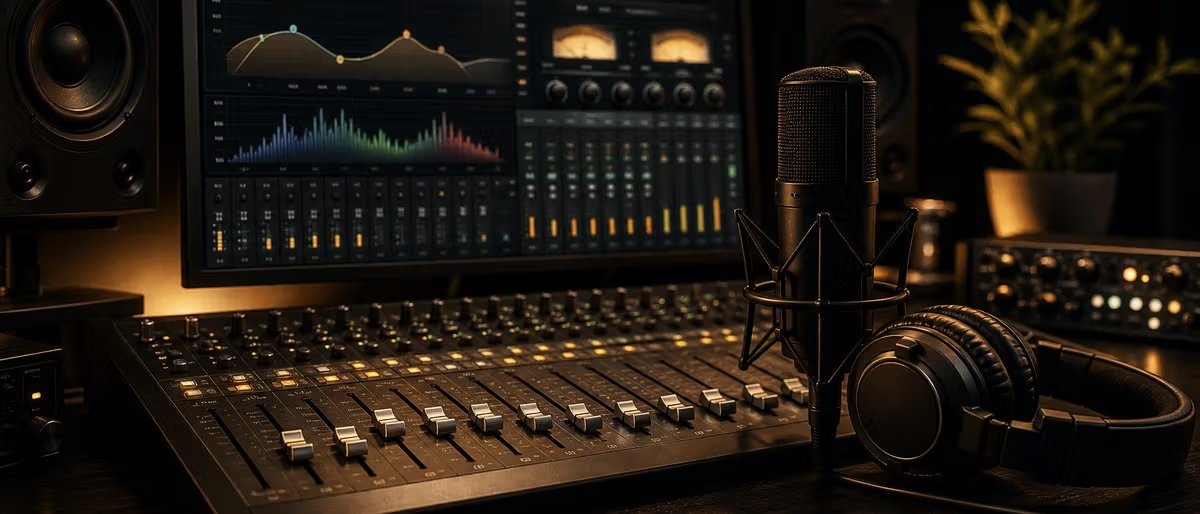
Quick answer: Travis Scott Vocal Chain
Quick Answer
Travis Scott's vocal chain starts with Auto-Tune (Retune Speed 20–40 ms), followed by EQ (high-pass 80–100 Hz, boost 3–5 kHz), serial compression (1176 → LA-2A), desaturation (Decapitator or RC-20), and spatial effects (Valhalla Vintage Verb, dotted 8th delay). The result is a wide, hyped vocal that sits forward in dense trap mixes.
What Defines the Travis Scott Vocal Sound?
Travis Scott's vocal sound is instantly recognizable: heavily processed, spatially wide, and sitting at the very front of the mix. The signature combines precise pitch correction, aggressive EQ shaping, harmonic saturation, and expansive reverb/delay effects. Unlike natural-sounding R&B vocals, Travis's voice is treated as an instrument — layered, effected, and designed to cut through dense trap productions.
The foundation is always a clean recording. Travis records in professional studios with high-end microphones (Neumann U87, Sony C-800G) and pristine preamps. You cannot fix a bad recording with plugins. Before applying any processing, ensure your vocal take is clean, comped, and edited for timing.
Auto-Tune: The Core of the Sound
Auto-Tune is the most identifiable element of Travis Scott's vocal chain. The effect is not subtle — it is deliberately audible, creating a robotic, hyped texture that has become synonymous with modern trap. The key is balancing Retune Speed: too fast sounds like a robot, too slow sounds off-key.
Set Auto-Tune to the key of your track. Use Retune Speed between 20 and 40 milliseconds for lead vocals. This range catches pitch drift quickly without creating the overly mechanical 'T-Pain effect.' For ad-libs and background vocals, push Retune Speed to 5–15 ms for maximum effect. Humanize should be set to 0–10 to preserve some natural variation.
- Set the key and scale
Match Auto-Tune's key to your track. Travis typically works in minor keys (C minor, D minor, F minor). Set the scale to Minor. - Adjust Retune Speed for leads
Lead vocals: 20–40 ms. This corrects pitch quickly while keeping a natural feel. Lower values = more robotic. - Push Retune Speed for ad-libs
Ad-libs and backgrounds: 5–15 ms. These layers are meant to sound effected and hyped, not natural. - Set Humanize to 0–10
Low Humanize keeps the correction tight. For a more natural sound on ballads, raise to 20–30.
EQ: The Radio-Ready Curve
Travis's vocals have a specific spectral signature: thin in the low mids, bright and airy in the highs, with a pronounced presence bump around 3–5 kHz. This curve helps the vocal cut through mixes that are already dense with 808s, synths, and drums.
Start with a high-pass filter at 80–100 Hz to remove rumble and low-end buildup. Cut 200–400 Hz by 2–4 dB to reduce muddiness and create the 'thin' quality. Boost 3–5 kHz by 2–3 dB for presence and intelligibility. Add a high-shelf boost at 10–12 kHz for 'air' and brightness. Use a narrow Q for cuts and a wide Q for boosts.
- High-pass at 80–100 Hz
Remove low-end rumble and prevent the vocal from competing with the 808 and kick. Use a 12 dB/octave slope. - Cut 200–400 Hz by 2–4 dB
This is the 'mud' range. Reducing it here creates the thin, radio-ready quality characteristic of Travis's voice. - Boost 3–5 kHz by 2–3 dB
The presence range. This is where the ear is most sensitive, and a gentle boost makes the vocal jump forward in the mix. - High-shelf boost 10–12 kHz
Add 'air' and brightness. +2 to +3 dB with a wide Q gives the vocal a polished, expensive sheen.
Serial Compression: 1176 into LA-2A
Travis's vocals are heavily compressed — not with a single plugin, but with two compressors in series. The first compressor (typically an 1176-style FET compressor) catches fast transients and adds aggression. The second (an LA-2A-style optical compressor) smooths the overall level and adds warmth.
Start with the 1176: set Ratio to 4:1 or 8:1, Attack to 3–5 (medium-fast), and Release to 5–7 (medium). Aim for 3–6 dB of gain reduction on peaks. Follow with the LA-2A: set Peak Reduction to 3–5 dB of gentle gain reduction. The serial combination gives you control over both micro-dynamics (1176) and macro-dynamics (LA-2A).
- Insert 1176-style compressor first
UAD 1176LN, Waves CLA-76, or stock FET compressor. Ratio 4:1 or 8:1, Attack 3–5, Release 5–7. 3–6 dB gain reduction. - Follow with LA-2A-style compressor
UAD LA-2A, Waves CLA-2A, or stock optical compressor. Peak Reduction for 3–5 dB gentle reduction. - Level-match after each compressor
Use the makeup gain to return the vocal to its original level. Loudness bias will trick you into thinking compressed = better.
Saturation and Harmonic Distortion
After compression, Travis's vocal chain adds harmonic saturation to create warmth and edge. The distortion is subtle — not a fuzz pedal, but a gentle thickening that makes the vocal sound larger than life. This is where the 'hyped' quality comes from.
Soundtoys Decapitator on the E or N setting with Drive at 15–25% adds analog warmth. For a more lo-fi texture, RC-20 Retro Color on the Wobble or Digital setting with 10–20% intensity adds movement and grit. For a free option, use the built-in tape saturation in your DAW or Vital's distortion module set to Tube mode at low drive.
Reverb and Delay: Creating the Astroworld Space
Travis's vocals exist in a massive, immersive space. The reverb is not a subtle room — it is a large hall or plate that creates a sense of scale. The delay is rhythmic and filtered, creating echoes that bounce around the stereo field without cluttering the mix.
For reverb, use Valhalla Vintage Verb on the Large Room or Dark Space setting. Set Decay to 2.5–4 seconds, Pre-Delay to 25–40 ms, and Mix to 15–25% on a send/return track. For delay, create a dotted 8th note delay (tempo-synced) on a separate send. Filter the delay to 2–5 kHz so it adds texture without competing with the dry vocal. Add a stereo widener (Waves S1 or stock widener) to the delay return for extra width.
- Set up a reverb send/return
Valhalla Vintage Verb: Large Room or Dark Space. Decay 2.5–4s, Pre-Delay 25–40 ms. Send vocal at 15–25% wet. - Create a dotted 8th delay send
Tempo-synced dotted 8th. Filter the return to 2–5 kHz. This creates rhythmic echoes without clutter. - Widen the delay return
Add a stereo widener to the delay return. Push width to 120–150% for a spacious, immersive feel.
Ad-Lib Processing: The Travis Scott Signature
Travis's ad-libs are not afterthoughts — they are a core part of the production. 'It's Lit!', 'Straight Up!', and 'Yeah!' are treated with heavy effects that make them sound like instruments rather than backing vocals. The processing is more extreme than the lead vocal.
Route ad-libs to a separate channel with heavier Auto-Tune (Retune Speed 5–15 ms), more distortion (Decapitator at 30–40% Drive), and a telephone EQ (high-pass 500 Hz, low-pass 3 kHz). Add a stereo delay with heavy feedback and a large reverb send. Pan ad-libs hard left and right to create a call-and-response effect around the centered lead vocal.
Quick-Reference: Travis Scott Vocal Chain
| Stage | Plugin/Setting | Purpose |
|---|---|---|
| Pitch correction | Auto-Tune, Retune 20–40 ms | Tight, audible pitch correction |
| EQ | High-pass 80–100 Hz, cut 200–400 Hz, boost 3–5 kHz | Thin, bright, radio-ready curve |
| Compression 1 | 1176-style, 4:1 or 8:1, 3–6 dB GR | Transient control and aggression |
| Compression 2 | LA-2A-style, 3–5 dB GR | Smoothing and warmth |
| Saturation | Decapitator or RC-20, 15–25% Drive | Harmonic thickness and hype |
| Reverb | Valhalla Vintage Verb, Large Room, 2.5–4s | Immersive spatial depth |
| Delay | Dotted 8th, filtered 2–5 kHz, widened | Rhythmic texture and width |
| Ad-libs | Heavy Auto-Tune, telephone EQ, distortion | Signature hyped background vocals |
Want free vocal presets and effect chains for trap production?
Learning path
Related answer hubs
Related articles
![Music Hackspace Getting Started With Interactivity With Max by Kyle Duffield [TUTORiAL]](/images/posts/music-hackspace-getting-started-with-interactivity-with-max--86081.avif?v=2026080101)
LEARNING / VIDEO TUTORIALS
Music Hackspace Getting Started With Interactivity With Max by Kyle Duffield [TUTORiAL]
![Music Hackspace Getting Started With Audio FX In Max by Massimiliano Cerioni [TUTORiAL]](/images/posts/music-hackspace-getting-started-with-audio-fx-in-max-by-mass-86062.avif?v=2026080101)
LEARNING / VIDEO TUTORIALS
Music Hackspace Getting Started With Audio FX In Max by Massimiliano Cerioni [TUTORiAL]
![30 Day Singer 14-Day Performance Course With Abram [TUTORiAL]](/images/posts/30-day-singer-14-day-performance-course-with-abram-86064.avif?v=2026080101)
LEARNING / VIDEO TUTORIALS
30 Day Singer 14-Day Performance Course With Abram [TUTORiAL]
![MixWithTheMasters Beck Recording and Producing Ride Lonesome [TUTORiAL]](/images/posts/mixwiththemasters-beck-recording-and-producing-ride-lonesome-86013.avif?v=2026080101)
LEARNING / VIDEO TUTORIALS
MixWithTheMasters Beck Recording and Producing Ride Lonesome [TUTORiAL]
![Truefire Bass Soloing Studies Vol.2 [TUTORiAL]](/images/posts/truefire-bass-soloing-studies-vol2-85693.avif?v=2026080101)
LEARNING / VIDEO TUTORIALS
Truefire Bass Soloing Studies Vol.2 [TUTORiAL]
![Lucid RnB Alchemy [WAV, MiDi, Synth Presets, TUTORiAL]](/images/posts/lucid-rnb-alchemy-85746.avif?v=2026080101)
Samples / Presets / MIDI / VIDEO TUTORIALS
Top 5%Lucid RnB Alchemy [WAV, MiDi, Synth Presets, TUTORiAL]
Frequently Asked Questions
- What microphone does Travis Scott use?
- Travis primarily uses the Neumann U87 Ai and the Sony C-800G in studio sessions. The C-800G is known for its extreme high-frequency detail and is a staple in high-end rap vocal recording. For home producers, the Audio-Technica AT2020 or Shure SM7B can achieve similar results with proper EQ.
- Can I get the Travis Scott vocal sound without expensive plugins?
- Yes. Use Graillon 2 (free) for pitch correction instead of Auto-Tune. Use TDR Nova (free) for EQ. Use Rough Rider 2 (free) for compression. Use Valhalla Supermassive (free) for reverb and delay. The chain matters more than the brand names.
- Why does my vocal sound thin after EQ?
- Thin vocals usually mean too much low-mid cut or not enough body compensation. After cutting 200–400 Hz, add a gentle boost at 100–150 Hz on a parallel track to restore warmth. Also check that your high-pass filter is not set too aggressively (keep it at 80–100 Hz, not 200 Hz).
- How loud should the vocal be in the mix?
- The lead vocal should sit 3–6 dB above the instrumental at its loudest points. Use a VU meter or LUFS meter to check: the vocal should peak around –6 dBFS while the instrumental peaks around –12 dBFS. Ad-libs should sit 6–10 dB below the lead vocal.
- What is the difference between Travis Scott's and Drake's vocal chains?
- Travis's chain is more aggressive: faster Auto-Tune, heavier saturation, larger reverb, and more extreme ad-lib processing. Drake's chain is warmer and more natural, with slower pitch correction, gentle compression, and a tighter, more intimate reverb. Travis sounds like a stadium; Drake sounds like a luxury lounge.