
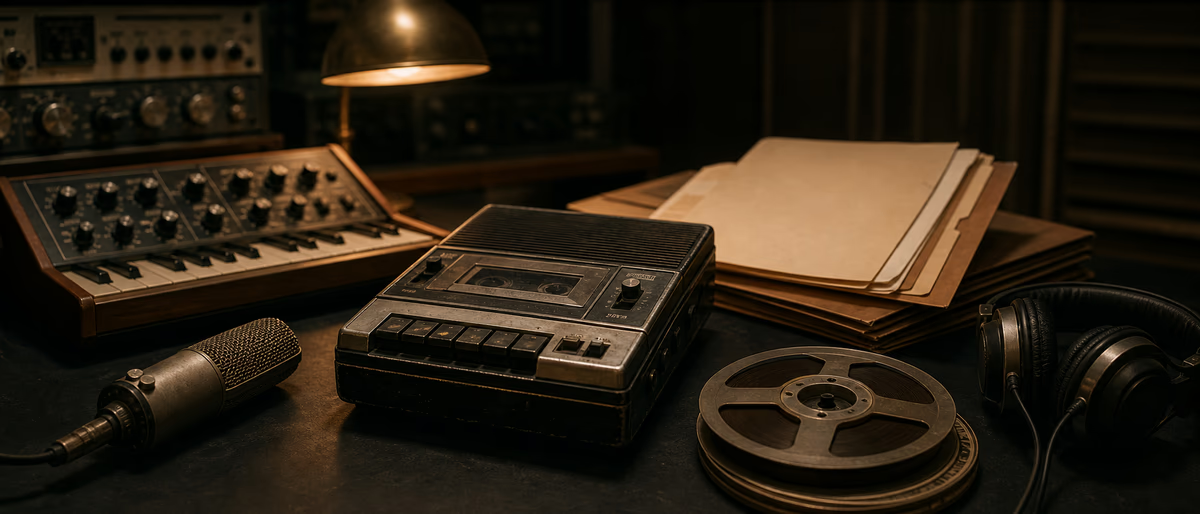
Vintage gear sampling checklist
Rights workflows should be documented before release, not reconstructed during a dispute.
- Save license PDFs or screenshots with timestamps.
- Keep split sheets and contributor approvals in the project folder.
- Record territory, term, allowed uses, and payment terms for each asset.
This is operational education for producers, not legal advice. For a signed deal, dispute, takedown, or high-value sync, ask a qualified music lawyer in the relevant territory.
Local context
Legal, tax, privacy, rights, royalty, and contract rules vary by jurisdiction. Use this article as an editorial starting point, not legal or accounting advice.
Before acting, verify local laws, payment methods, platform availability, taxes, and music-rights administration for your country.
Quick Answer
Vintage gear sampling checklist: Vintage gear does not automatically make a sound copyright-safe. Record whether the source is your own performance, a factory preset, a ROM sample, a demo pattern, or a protected recording, then decide whether release, sync, or sample-pack resale is allowed. This is operational education for producers, not legal advice. For a signed deal, dispute, takedown, or high-value sync, ask a qualified music lawyer in the relevant territory.
What producers should actually document
Vintage gear does not automatically make a sound copyright-safe. Record whether the source is your own performance, a factory preset, a ROM sample, a demo pattern, or a protected recording, then decide whether release, sync, or sample-pack resale is allowed.
Treat clearance as chain-of-title work: who owns the recording, who owns the composition, what use was approved, what territory and term apply, and who gets paid.
A credit line, DM, beat-store receipt, or friendly verbal yes can be useful evidence, but it is not the same as a license that names the rights and permitted exploitation.
Hardware sound
Recording your own synth, drum machine, sampler, or tape noise is usually different from sampling a protected record.
Producer action Document that the performance and recording were yours.
Factory presets and demos
Some vintage gear includes copyrighted patterns, demo songs, ROM samples, or third-party libraries.
Producer action Check manuals and license notes before packaging raw sounds.
Resale and sample packs
Selling isolated multi-samples can trigger different restrictions than using sounds inside a song.
Producer action Avoid redistributing protected factory content as raw assets.
Risk map before release
| Area | Common failure | Conservative move |
|---|---|---|
| Sampling a record through vintage gear | The gear does not erase the original copyright | Clear or replace the source. |
| ROMpler multi-samples | Factory libraries may restrict extraction or resale | Use original performances in tracks, not raw library clones. |
| Demo-song riffs | Preset demos can be protected compositions | Write new parts and avoid recognizable demo material. |
| Marketplace pack claims | Buyers need clear provenance | Include recording notes and excluded-source statements. |
Jurisdiction notes for international releases
Use this as a routing map, not legal advice. A beat uploaded from one country can generate claims in another because platforms, PROs, publishers, labels, and neighboring-right societies each operate on their own rules.
| Territory | Operational caution |
|---|---|
| US | Separate master, composition, mechanical, performance, sync, and DMCA processes. SoundExchange applies to non-interactive digital performance royalties for recordings. |
| EU/EEA | Moral rights and collective-management rules can be stricter than a US-only workflow. Platform takedowns and neighboring rights can involve local societies. |
| UK | PRS, MCPS, and PPL often sit in different parts of the rights stack. Do not assume a US PRO registration covers UK exploitation cleanly. |
| Brazil | ECAD and local publishing administration can affect public performance and neighboring-right collections. Portuguese contract language may matter. |
| Russia | Local collection and enforcement conditions can change quickly. Keep contracts, source files, and payment evidence in case platforms request proof. |
| China | Platform clearance, lyric use, and local distribution rules may require local partner review before release or sync use. |
| Japan/Korea | JASRAC, NexTone, KOMCA, and local neighboring-right workflows can be precise about splits, covers, and sync. Metadata accuracy matters. |
| Turkey/Indonesia | Local collecting societies and platform policies may diverge from US templates. Confirm language, term, and territory in writing. |
| Spanish multi-region | Spain, Mexico, Colombia, Argentina, Chile, and other Spanish-speaking markets are not one legal region. Use country-specific review for campaigns. |
| Arabic multi-region | MENA markets vary by country, platform, and local partner. Treat Arabic-language exploitation as multi-territory unless a contract says otherwise. |
Clearance and enforcement workflow
- 1. Identify the source
Original performance, factory preset, ROM sample, record sample, field recording, or third-party card. - 2. Check the manual and license
Look for restrictions on redistribution, sample libraries, and commercial use. - 3. Record provenance
Photograph gear, save patch notes, date the session, and label any external media. - 4. Package cautiously
For sample packs, sell transformed original recordings, not cloned factory libraries. - 5. Keep buyer terms plain
State commercial music use, raw-file redistribution limits, Content ID limits, and territory if relevant.
Red flags that should stop the upload
| Red flag | Why it matters | What to do |
|---|---|---|
| No source file or license text | You cannot prove what rights came with the asset. | Pause release until the vendor, collaborator, or rights owner confirms terms in writing. |
| Worldwide sync or broadcast promised in a casual message | Sync and broadcast often need explicit rights language. | Ask for a formal license or exclude the use from the pitch. |
| Multiple writers but no split sheet | Publishing money may be misdirected or frozen. | Get dated approvals before distribution. |
| A platform claim arrives before release day | Fingerprinting can reveal hidden samples or duplicate loops. | Resolve the claim before pitching editors, ads, or sync buyers. |
This is operational education for producers, not legal advice. For a signed deal, dispute, takedown, or high-value sync, ask a qualified music lawyer in the relevant territory.
Use Plugg Supply as a source-control step for music assets: keep license notes, source links, stems, and export metadata together before release.
Learning path
Related answer hubs
Frequently Asked Questions
- Can I sell samples from an old synth?
- Often you can sell original recordings of your own performances, but cloning factory libraries or demo songs can be restricted. Check the manual and source.
- Does running a record through a sampler clear it?
- No. The original recording and composition rights remain.
- Are drum machine hits safe?
- Original drum machine hits are often lower risk than record samples, but factory patterns, ROM content, and trademark-style marketing still need care.
- What should I include in a pack license?
- Commercial music use, no raw redistribution, no false authorship, Content ID limits, and any excluded territories or uses.