
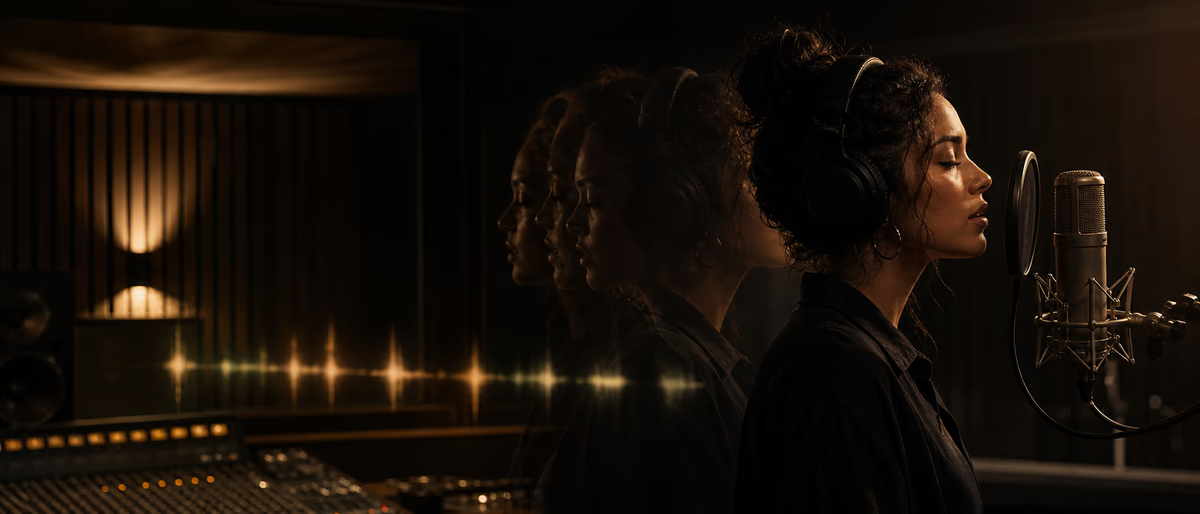
Quick answer: AI Voice Doubles and Harmonies
Quick Answer
AI doubles and harmonies are safest when generated from your own voice or a consenting vocalist for the same song. Do not use AI harmony tools to create hidden celebrity soundalikes, reuse vocalist models outside consent, or sell generated vocal stems as royalty-free without clear rights.
Short answer for producers
Doubles and harmonies may feel less risky than lead voice cloning, but they can still identify a singer, alter a performance, or create a synthetic feature. The legal and quality baseline is consent plus clear project scope.
This is practical publishing and platform-risk guidance, not legal advice. If a release depends on a major fee, exclusive license, sync placement, impersonation question, or disputed catalog, get jurisdiction-specific legal review before upload.
The safest pattern is simple: use AI as an assistive production tool, keep human creative control visible, avoid impersonation or unlicensed source material, disclose AI use when asked, and save evidence of every license, consent, prompt, edit, and export.
Regional rights and disclosure map
AI music policy is not global. Copyrightability, personality and voice rights, disclosure duties, consumer rules, platform terms, and data or training obligations vary by territory and by the role you play: artist, producer, distributor, label, tool provider, or dataset owner.
Use this map as a routing checklist before localizing metadata, ads, cover art, lyrics, vocal claims, or catalog terms.
| Market | Producer-safe reading |
|---|---|
| US | Human authorship remains central for copyright claims. Voice and likeness risk is handled through state publicity, unfair competition, contracts, and platform rules. Disclose AI when the platform, distributor, ad partner, or copyright filing asks for it. |
| EU/EEA/UK | Expect stricter transparency, consumer protection, data protection, and AI Act/GPAI duties around training summaries, synthetic media labels, and rights reservations. UK rules are not identical to EU rules, so treat them separately for commercial releases. |
| China | Generated or synthetic text, image, audio, and video services face explicit and implicit labeling expectations. Platforms can be stricter than copyright law, especially for voice, celebrity, news, and consumer-facing content. |
| Japan/Korea | Text-and-data-mining, training, copyrightability, and performer/personality questions are evolving differently. Do not assume a model trained legally in one market is safe to commercialize in another. |
| Brazil | Copyright, consumer protection, personality rights, LGPD privacy rules, and AI-policy proposals can all matter for voice, image, fan-facing disclosure, and dataset handling. |
| Russia | Copyright and personal non-property rights can apply differently from US/EU assumptions. Keep licenses, permissions, and platform evidence in Russian-market campaigns. |
| Turkey/Indonesia | Local copyright, advertising, consumer, data, and morality/public-order rules can affect synthetic voice, AI artwork, and monetized platform uploads. Use conservative disclosure when targeting these markets. |
| Spanish/Arabic-language markets | Do not treat language as a single legal zone. Spain, Mexico, Argentina, Colombia, Gulf states, Egypt, Saudi Arabia, and North Africa differ on copyright, moral rights, publicity, privacy, and consumer disclosure. |
Platform-safe workflow
- Start from cleared vocals
Use your own take or a vocalist who approved AI doubling, harmony generation, and release. - Keep the lead honest
Do not transform a normal vocal into a recognizable artist imitation. - Edit musically
Tune, de-ess, time-align, formant-check, and automate doubles so they support the song instead of creating uncanny artifacts. - Label stems internally
Mark AI-generated harmonies so mixers, labels, and clients know what they are approving. - Disclose for clients and platforms
If synthetic vocals are material to the track or requested in metadata, disclose them.
Rights checklist
- Vocalist approval A session singer should know if their voice will generate new notes or harmonies.
- Stem resale Generated harmonies may not be reusable as a sample product unless the agreement permits it.
- Moral and integrity rights Some markets care about distortion or alteration of a performance.
- Quality control Artificial formants, timing drift, and sibilance buildup can reveal the process and reduce trust.
Common risk points
| Risk | Why it matters | Conservative move |
|---|---|---|
| Unapproved extra vocals | A vocalist may object to generated performances they never sang. | Add AI harmony consent to the release. |
| Celebrity backing texture | A background stack can still imitate a recognizable voice. | Use neutral or licensed models. |
| Sample pack vocals | Buyer rights may be unclear. | Offer only vocals you own and can sublicense. |
| Undisclosed client delivery | Clients may need to clear AI use with labels or ad partners. | Include AI notes in delivery documentation. |
Documentation to keep
- Tool terms at time of export Save the plan page, commercial-use clause, model/version notes, and any AI disclosure policy that applied when you generated or exported the asset.
- Human contribution record Keep DAW sessions, stems, MIDI, lyrics drafts, arrangement notes, mix revisions, and screenshots that show creative control beyond a prompt.
- Source and consent trail Archive sample licenses, vocalist releases, artwork permissions, cover-song licenses, opt-out notices, takedown responses, and distributor correspondence.
- Market-specific upload notes Record which territories were targeted, which metadata fields mentioned AI, and which platforms required labels, checkboxes, or synthetic-media declarations.
When you need verified free plugins or one-shots without sketchy mirrors, browse Plugg Supply and request delivery through Telegram.
Learning path
Related answer hubs
Related catalog
More tutorials from the catalog
More tutorials from the Plugg Supply feed, ranked by catalog popularity.
![Musihacks Jaime Altozano Curso Piano Acompañamientos (Intermedio) [TUTORiAL]](/images/posts/musihacks-jaime-altozano-curso-piano-acompanamientos-interme-82295.avif?v=2026080101)
![789ten The DubVision Producer Pack v.6 [WAV, MiDi, Synth Presets, TUTORiAL]](/images/posts/789ten-the-dubvision-producer-pack-v6-86546.avif?v=2026080101)
Samples / Presets / MIDI / VIDEO TUTORIALS
789ten The DubVision Producer Pack v.6 [WAV, MiDi, Synth Presets, TUTORiAL]
![MixWithTheMasters Kevin Parker Producing 'Dracula' [TUTORiAL]](/images/posts/mixwiththemasters-kevin-parker-producing-dracula-86234.avif?v=2026080101)
LEARNING / VIDEO TUTORIALS
MixWithTheMasters Kevin Parker Producing 'Dracula' [TUTORiAL]
![FaderPro The One Hour Mixing Workflow [TUTORiAL]](/images/posts/faderpro-the-one-hour-mixing-workflow-84119.avif?v=2026080101)
LEARNING / VIDEO TUTORIALS
FaderPro The One Hour Mixing Workflow [TUTORiAL]
Related articles
LEARNING / VIDEO TUTORIALS
HotMusihacks Jaime Altozano Curso Piano Acompañamientos (Intermedio) [TUTORiAL]
Samples / Presets / MIDI / VIDEO TUTORIALS
Hot789ten The DubVision Producer Pack v.6 [WAV, MiDi, Synth Presets, TUTORiAL]
LEARNING / VIDEO TUTORIALS
TrendingMixWithTheMasters Kevin Parker Producing 'Dracula' [TUTORiAL]
LEARNING / VIDEO TUTORIALS
TrendingFaderPro The One Hour Mixing Workflow [TUTORiAL]
![SoniX KXVI Vintage Mastery Production Course [TUTORiAL]](/images/posts/sonix-kxvi-vintage-mastery-production-course-82050.avif?v=2026080101)
LEARNING / VIDEO TUTORIALS
TrendingSoniX KXVI Vintage Mastery Production Course [TUTORiAL]
![Production Music Live Arrangement Academy [TUTORiAL]](/images/posts/production-music-live-arrangement-academy-78917.avif?v=2026080101)
LEARNING / VIDEO TUTORIALS
TrendingProduction Music Live Arrangement Academy [TUTORiAL]
Frequently Asked Questions
- Can I make AI harmonies from my own vocal?
- Usually yes, subject to the tool terms and platform disclosure rules.
- Can I make harmonies from a guest vocalist take?
- Only if the vocalist agreed to AI generation or the contract clearly covers it.
- Are AI doubles detectable?
- Often yes through artifacts, metadata, or production notes. Plan for transparency.
- Do harmonies need copyright registration disclosure?
- If AI-generated material is material to a registered work, follow the relevant office rules for identifying AI content.