
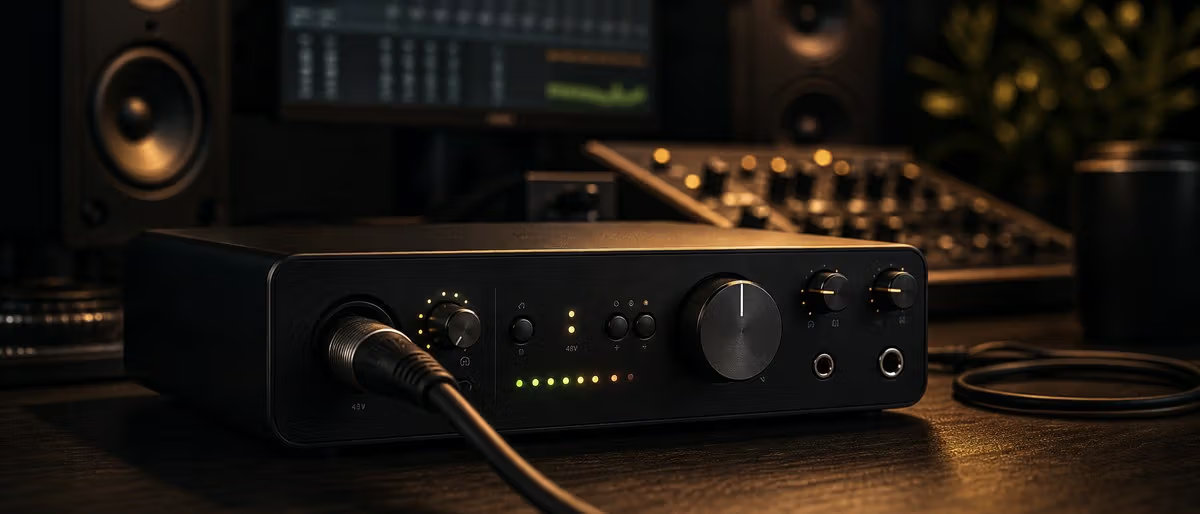
The Microphone Is the First Link in Your Chain — Choose the Right One
The microphone is the first piece of equipment in your recording signal chain, and it does something no other piece of gear can: it translates acoustic energy into an electrical signal. That conversion — called transduction — shapes every characteristic of your recording before a single plugin touches it. Choose the wrong microphone and you spend your entire mix fighting to fix problems that were baked in at the source. Choose the right one and half your mixing work is already done.
This guide compares condenser and dynamic microphones across every dimension that matters: how they work internally, what they do to your sound, where each technology excels, and how to decide which belongs in your studio.
Introduction — The Transducer Principle
Every microphone is a transducer: a device that converts one form of energy into another. In this case, acoustic energy (sound waves traveling through air) becomes electrical energy (the analog signal that flows through your preamp, interface, and DAW). The way each microphone type accomplishes this transduction defines its character, capabilities, and ideal use cases.
The two dominant microphone technologies — condenser and dynamic — approach this problem in fundamentally different ways. Condenser microphones use an electrostatic principle involving a charged capacitor. Dynamic microphones use an electromagnetic principle involving a coil moving through a magnetic field. Both have been refined over decades into highly sophisticated instruments, and both have scenarios where they outperform the other.
Understanding the underlying physics is not academic trivia — it is the foundation for making intelligent microphone choices that serve your recordings rather than creating remedial problems for your mix session.
How Condenser Microphones Work
Condenser microphones are the dominant technology in studio recording. Their name comes from the core component: a capacitor (historically called a condenser) with a thin metal or metalized polymer diaphragm stretched near a fixed backplate. This capsule is the heart of the microphone.
Capacitor Capsule with a Charged Diaphragm
The diaphragm and backplate form two plates of a capacitor, separated by a microscopic air gap. The diaphragm is stretched taut and must be extremely thin — typically 2 to 5 microns thick, about one-tenth the diameter of a human hair. When a sound wave hits the diaphragm, it vibrates, changing the distance between the diaphragm and the backplate. Because capacitance is inversely proportional to the distance between plates, this movement produces a corresponding change in electrical voltage across the capsule.
For the capsule to produce a usable signal, the diaphragm must maintain an electrical charge. This is supplied either by an external 48V phantom power source (the industry standard, called P48) or by an internal battery in some portable designs.
Phantom Power Requirement (+48V)
Phantom power is a 48-volt DC current sent through the microphone cable from your audio interface or mixer. It provides the necessary polarizing voltage for the capsule and powers the internal impedance-converting preamp (typically a field-effect transistor or FET circuit). Without phantom power, a standard condenser microphone produces no signal.
Almost all professional audio interfaces and mixers provide phantom power on their XLR inputs, switchable per channel or globally. It is called "phantom" because the power travels invisibly through the same cable that carries the audio signal — no separate power cable is needed.
One important note: never connect a condenser microphone to a mixer or interface that does not provide phantom power without first verifying the microphone has an alternative power source. Similarly, while modern dynamic microphones are unaffected by phantom power (it does not reach the capsule), older ribbon microphones can be damaged by it — always check your ribbon mic's specifications before applying phantom power.
Diaphragm Size: Large-Diaphragm vs Small-Diaphragm
The diameter of the diaphragm is one of the most significant differentiators in condenser microphone design, and it has real consequences for your recordings.
Large-diaphragm condensers (LDCs) have capsule diameters of 1 inch (25mm) or larger. The Neumann U87, Rode NT1, Audio-Technica AT2020, and AKG C414 are all LDCs. The larger diaphragm mass means it responds to sound more slowly, which creates a characteristically warm low-end response and a natural proximity effect (a bass boost that occurs when the microphone is placed close to the sound source). LDCs are the industry standard for vocal recording because they add a pleasing sense of presence and fullness to human voices.
Small-diaphragm condensers (SDCs) have capsule diameters under 1 inch. The Rode NT5, Neumann KM184, AKG C451, and DPA 4006 are well-known SDCs. The smaller, lighter diaphragm responds to sound waves more quickly, capturing transients with greater accuracy and producing a more neutral, transparent frequency response. SDCs are the choice for acoustic instruments, drum overheads, and any application where accuracy is preferred over character.
Frequency Response: Wide, Extended, Accurate
Condenser microphones typically offer flat, extended frequency response from around 20Hz to 20kHz or beyond. This means they reproduce the full audible spectrum without the significant colorations that many dynamic microphones introduce. A high-quality condenser will capture frequencies you may not consciously hear but which contribute to the overall timbre and realism of a recording.
However, "flat" does not mean "same." Different condenser microphones have different frequency response curves — some have a presence peak around 3-6kHz that adds clarity and bite to vocals, others have a gentle high-frequency roll-off that sounds smoother and less harsh. Understanding these variations is key to matching a microphone to a voice or instrument.
Sensitivity and Self-Noise Trade-Off
Condenser microphones are significantly more sensitive than dynamics — they produce a higher output voltage for the same acoustic input. This is an advantage when capturing quiet sources or distant microphone positions, but it also means they are more sensitive to background noise, room reflections, and handling noise.
The trade-off for this sensitivity is self-noise. Because the internal preamp is always running (when phantom power is applied), every condenser microphone generates some electrical noise. This is measured in dB-A (A-weighted decibels) and listed in specifications as "equivalent noise level" or "self-noise." The Rode NT1 at 4.5dB-A is among the quietest microphones ever made at any price. The Audio-Technica AT2020 at 20dB-A is noisier but still perfectly usable for vocal recording. As a practical reference: a quiet room measures approximately 30-35dB-A, so a microphone with 20dB-A self-noise is effectively silent in normal recording environments.
How Dynamic Microphones Work
Dynamic microphones are the workhorses of live sound and a legitimate creative choice in the studio. Their operation is conceptually simple and mechanically robust, which is why they are the most durable microphones available.
Moving Coil Magnet Principle (Like a Speaker in Reverse)
A dynamic microphone works on the same principle as a loudspeaker, but in reverse. In a speaker, an electrical audio signal passes through a coil of wire suspended in a magnetic field, causing the coil to move and drive a cone that pushes air — producing sound. In a dynamic microphone, sound waves push a diaphragm that is attached to a small coil of wire. The coil is suspended in a static magnetic field, and as it moves, it generates a small electrical current proportional to the velocity of the diaphragm's movement.
This electromagnetic induction process produces a signal without any external power source. The coil is attached directly to the diaphragm, so the entire assembly moves together as a single mass.
No Power Required
Dynamic microphones are passive devices — they generate their own electrical signal through electromagnetic induction and require no external power source. This makes them extremely simple to operate: plug and record. There is no phantom power to engage, no batteries to replace (in most cases), and no internal circuitry that can fail due to power issues.
Rugged Construction, Handles Abuse
The moving coil design has no delicate thin-film components. The diaphragm is typically a reinforced polymer or mylar, and the coil is wound from sturdy copper wire. There are no fragile backplates, no capacitor elements to degrade, and no circuits to fail from moisture or impact. This makes dynamic microphones the standard for live touring, broadcast, and any environment where equipment is moved frequently or exposed to rough handling.
The Shure SM7B — one of the most widely-used dynamic microphones in both broadcast and studio — has a built-in shock mount and pop filter integrated into its chassis. It weighs over a kilogram and feels like it was machined from a single block of metal. That is not an accident: the construction quality directly translates into mechanical reliability.
Frequency Response: More Colored, Often Hyped in High-Mids
The frequency response of dynamic microphones is typically less flat than that of condensers. The moving coil and diaphragm assembly has more mass than a condenser diaphragm, which means it responds less quickly to transient attacks and rolls off more sharply at high frequencies. Most dynamic microphones begin to attenuate somewhere between 12kHz and 16kHz.
Many popular dynamic microphones also have a characteristic high-mid presence peak — a boost in the 2-5kHz range that adds clarity and bite to voices and instruments. The Shure SM58 has a well-known presence peak around 4-5kHz that cuts through a live mix. The SM7B has a smoother response but still carries the dynamic microphone character of a somewhat "hyper" midrange.
This coloration is not a flaw — it is a deliberate character that works extremely well in specific contexts. The presence peak in a dynamic microphone can make a voice cut through a dense mix without needing EQ. The reduced high-frequency sensitivity means sibilance and harshness are naturally tamed.
SPL Handling Capability
Dynamic microphones handle extremely high sound pressure levels (SPL) without distortion. The coil mass and magnetic field strength allow the diaphragm to move large distances without mechanical constraint. A typical dynamic microphone is rated for 130-140dB SPL or higher. The Shure SM58 is specified to handle 180dB SPL in laboratory conditions. This makes dynamics the obvious choice for close-miking loud sources like guitar cabinets, snare drums, and bass amplifiers.
Condenser microphones can also handle high SPL — many professional condensers are rated to 130dB+ with higher-SPL versions available — but the diaphragm excursion limits of a condenser design mean they distort more readily at extreme sound pressure levels than dynamics do.
Key Differences Comparison Table
| Feature | Condenser Microphone | Dynamic Microphone |
|---|---|---|
| Operating Principle | Electrostatic (capacitor capsule) | Electromagnetic (moving coil) |
| Power Requirement | 48V phantom power required | No power required (passive) |
| Sensitivity | High — produces strong output | Low — requires more gain |
| Frequency Response | Wide, flat, extended (20Hz-20kHz+) | Narrower, colored, rolls off highs (~16kHz) |
| SPL Handling | Good to excellent (130dB+ typical) | Excellent — handles extreme SPL (140dB+) |
| Self-Noise | Varies; as low as 4.5dB-A (quiet) | Very low self-noise (inherently quiet) |
| Durability | Fragile — sensitive to humidity, shock, dust | Extremely rugged, built for abuse |
| Diaphragm Mass | Very light (2-5 micron films) | Heavy (copper coil attached to diaphragm) |
| Transient Response | Excellent — captures fast transients accurately | Moderate — slower diaphragm response |
| Room Sensitivity | High — captures room reflections and noise | Low — rejects off-axis sound naturally |
| Typical Price Range | $50-$300 (consumer/prosumer), $500-$3000+ (professional) | $50-$150 (live), $300-$500 (studio) |
| Best Known Models | Neumann U87, Rode NT1, AT2020, AKG C414 | Shure SM58, SM7B, Electro-Voice RE20 |
When to Use Condenser Microphones
Condenser microphones are the professional studio standard for a reason. Their accuracy, sensitivity, and extended frequency response make them the ideal tool in environments and applications where these qualities can be fully exploited.
Studio Vocal Recording (The Industry Standard)
When recording vocals in a treated studio environment, the large-diaphragm condenser is almost always the first choice. The combination of wide frequency response, high sensitivity, and accurate transient reproduction means every nuance of a vocal performance is captured — breath sounds, consonant attacks, vowel textures, and room ambience are all preserved with fidelity that no dynamic microphone can match at the same price point.
The Neumann U87 has been the defining studio vocal microphone for over 50 years. Its large-diaphragm capsule, switchable polar patterns (cardioid, omnidirectional, figure-8), and gentle presence peak around 5kHz make it a flattering yet honest recorder of the human voice. At a more accessible price, the Rode NT1 and Audio-Technica AT2020 deliver 90% of the fidelity at a fraction of the cost.
Acoustic Guitar and Orchestral Instruments
Acoustic guitars produce a complex harmonic spectrum with delicate string attack and body resonance that benefits from the fast transient response and extended high-frequency response of condenser microphones. A small-diaphragm condenser pointed at the 12th fret, 8-12 inches from the soundhole, captures the full harmonic character of the instrument with accuracy that translates well in a mix.
Orchestral and classical recording — violin, cello, woodwinds, brass, piano — are exclusively the domain of condenser microphones. The nature of these instruments, played in acoustic spaces, demands the most accurate capture possible. Stereo pairs of small-diaphragm condensers in coincident or spaced configurations are the standard approach for orchestral recording.
Room/Ambient Recording
Because condenser microphones are so sensitive and accurate, they excel at capturing the sound of a room. Omni-directional condensers placed at a distance from the source record the full acoustic environment — early reflections, reverberation, and the natural ambience of the space. This is an essential technique for capturing drums, full ensembles, and acoustic instruments where the room sound is a desired component of the recording.
Drum Overheads and Cymbal Mics
Drum overhead recording is one of the most demanding microphone applications because the overhead microphones capture the entire kit — cymbals, toms, snare, and room ambience — in stereo. Small-diaphragm condensers are the standard choice because their accurate transient response captures cymbal attack and decay without adding harshness, and their extended high-frequency response preserves the full shimmer of the cymbals.
A matched pair of Rode NT5s or Neumann KM184s in an X/Y configuration overhead a drum kit is a professional standard that works across genres from jazz to rock to electronic music.
Podcasting and Voiceover (With a Quiet Room)
When you have a treated recording space with good acoustic panels and minimal background noise, a condenser microphone captures voice with a natural, broadcast-quality presence that dynamic microphones sometimes lack. The Audio-Technica AT2020 or Rode NT1 are excellent choices for podcasters and voiceover artists who have invested in acoustic treatment.
Limitations: Humidity, Fragility, Picks Up Everything
Condenser microphones are precision instruments that demand respect. The thin diaphragm is vulnerable to physical shock — dropping a condenser microphone can permanently damage the capsule. High humidity can degrade the diaphragm over time, which is why condenser microphones should be stored with desiccant packs when not in use in humid environments. Condenser microphones also pick up absolutely everything: every reflection in your room, every traffic noise outside, every air conditioning hum, every footstep on a creaky floor. They are unforgiving in untreated spaces, which is why pairing a condenser microphone purchase with acoustic treatment is strongly recommended.
When to Use Dynamic Microphones
Dynamic microphones dominate live sound for good reason, and their studio applications are broader than many engineers realize. Understanding where dynamics excel opens up creative possibilities and practical solutions for challenging recording environments.
Live Sound Reinforcement (The Standard)
Dynamic microphones are the backbone of live sound. The Shure SM58 has been the standard live vocal microphone since the 1960s because it sounds good, takes physical abuse, rejects feedback in typical stage monitor configurations, and costs under $100. The SM58's presence peak cuts through a loud band mix, its rugged construction survives touring, and its cardioid polar pattern focuses on the performer's voice while rejecting stage monitor wedges positioned behind the microphone.
Close-Miking Loud Sources (Guitar Cab, Snare, Toms)
The guitar cabinet is the defining application for dynamic microphones in studios. A Shure SM57 placed 1 inch from the speaker cone, aimed slightly off-center from the dust cap, captures the full low-mid weight and aggressive attack of an electric guitar amplifier with controlled proximity effect and natural compression from the high SPL. The SM57 is so effective for guitar cabinets that it is arguably the most recorded microphone in popular music history — and it costs about $100.
The same logic applies to snare drums and tom-toms: dynamics handle the high SPL without distortion, their natural high-mid presence adds cut to the mix, and their relatively compact polar pattern rejects bleed from adjacent drums better than large-diaphragm condensers in many configurations.
Broadcast and Voice-Over
The Shure SM7B is the defining broadcast microphone. Its predecessor, the SM7, was famously used to record Michael Jackson's "Billie Jean" on the album that defined the sound of 1980s pop. The SM7B's smooth, broadcast-ready frequency response, integrated pop filter and shock mount, and exceptional background rejection make it the first choice for radio broadcasters, podcasters, and voice-over artists who need a professional sound without acoustic treatment.
Recording in Untreated Rooms
This is where dynamic microphones earn their keep in home studios and project studios without professional acoustic treatment. In a room with bare walls, parallel surfaces, and reflective echo, a condenser's sensitivity becomes a liability. Every reflection and reverb is recorded, degrading the clarity of the direct source sound. A dynamic microphone's less sensitive, more directional character naturally rejects these reflections, producing cleaner recordings in problematic spaces.
The Shure SM7B is the most commonly recommended microphone for home studio vocalists recording in untreated rooms, specifically because its sound rejection characteristics make a bad room sound acceptable.
Stage Vocal Recording
For live performances being recorded directly, dynamic microphones are preferred because they are less susceptible to feedback in live monitoring situations, can handle the SPL of a live PA system, and do not require the careful gain staging that condenser microphones demand in high-SPL live environments.
Kick Drum and Bass Amps
The Electro-Voice RE20 is the gold standard for kick drum recording. Its variable-D polar pattern (a unique design that changes pattern depending on the distance from the source) reduces proximity effect at close distances while maintaining tight cardioid rejection. Placed a few inches inside the kick drum port, the RE20 captures the full low-end weight and beater attack of the kick drum with authority. Similarly, for bass amplifier recording, dynamic microphones like the Electro-Voice RE20 and Shure SM7B are preferred over condensers for the same reasons of SPL handling and controlled low-end response.
The Studio Comeback for Dynamic Vocal Microphones
Counterintuitively, dynamic microphones are experiencing a renaissance in studio vocal recording. Engineers and producers are rediscovering that the natural compression, controlled high-mids, and reduced sibilance of dynamic microphones can be exactly what a vocal needs to sit in a dense mix without excessive EQ or compression. The SM7B has become a hip-hop and R&B studio standard alongside its broadcast legacy. TheTelefunken M80, a higher-end dynamic microphone designed for studio use, has found significant popularity for vocals where a condenser would sound too bright or harsh.
Large-Diaphragm vs Small-Diaphragm Condenser
The distinction between large-diaphragm and small-diaphragm condensers is one of the most practical decision points in microphone selection, and the difference is not merely one of size — it reflects fundamental trade-offs in acoustic behavior.
LDC: Warmth, Proximity Effect, Flattering on Vocals
Large-diaphragm condensers are optimized for vocal recording and are the dominant choice in recording studios worldwide. The larger diaphragm mass creates a more pronounced proximity effect — a bass boost that occurs as the microphone is placed closer to the sound source. At a typical vocal distance of 6-12 inches, this proximity effect adds warmth and fullness to voices that sounds flattering and present. Many vocalists instinctively move toward and away from a microphone while singing, and an LDC captures this dynamic movement naturally.
LDCs also tend to have a more colored frequency response than SDCs, with often a subtle presence peak around 3-6kHz that adds clarity and "air" to vocals. The Neumann U87's famous presence peak around 5kHz has been a defining vocal sound on countless hit records. This coloration is not neutral, but it is consistently described as "warm" and "flattering," which makes it a reliable starting point for vocal recording.
The trade-off is that LDCs are less accurate at capturing fast transients than SDCs. The larger diaphragm mass means it takes slightly longer to start and stop moving in response to sound waves. For sources where absolute transient accuracy is paramount, this can be a limitation.
SDC: Accuracy, Transient Response, Better for Acoustic Instruments
Small-diaphragm condensers are the precision tools of the microphone world. The tiny, lightweight diaphragm responds to sound waves with minimal mass loading — it starts and stops moving faster than an LDC diaphragm, capturing transients with significantly greater accuracy. This makes SDCs the ideal choice for acoustic instruments, drum overheads, orchestral recording, and any application where the most accurate representation of the source is desired.
SDCs typically have a flatter, more neutral frequency response than LDCs. There is less of the "character" that makes LDCs flattering on vocals — SDCs reproduce what is there rather than adding their own sonic signature. For acoustic guitar, this means the full harmonic complexity of the instrument is captured without additional coloring. For drum overheads, it means cymbals are reproduced with their natural decay and shimmer rather than being hyped in the presence range.
SDCs also perform better in stereo array configurations. Matched stereo pairs of SDCs in coincident X/Y or spaced omnidirectional configurations are the professional standard for overhead drum recording, room miking, and orchestral capture because their consistent, neutral response produces a coherent stereo image.
The trade-off is that SDCs are less forgiving than LDCs. Their accuracy means every acoustic problem in your room is captured. Their smaller diaphragm also means they produce a lower output level, which demands more clean gain from your preamp.
The Room Factor — Why Your Room Determines Which Mic to Choose
No factor influences microphone selection more practically than the acoustic environment in which you record. This is the variable that most beginning home studio producers underestimate, and it is the reason professional studios invest tens of thousands of dollars in acoustic treatment.
Condenser = Reveals Room Problems
A condenser's job is to capture sound with maximum accuracy. That is its entire design philosophy. But accuracy is a double-edged sword: when you point a condenser microphone at a vocalist in an untreated room, it captures every reflection bouncing off the bare walls, every echo from the parallel floor and ceiling, every bit of traffic noise from outside, and every mechanical hum from your computer. These artifacts are recorded directly into your track and cannot be removed in mixing — they are baked into the recording.
The result is a vocal track that sounds washed out, distant, and reverberant, with a murky low-mid buildup from sbthe room's standing waves and flutter echo between parallel surfaces. No amount of EQ, compression, or reverb can fully fix this. It must be prevented at the source, which means either treating the room or choosing a microphone that is less sensitive to the room's acoustics.
Quick room test: clap your hands sharply in your recording space. If you hear a long, ringing decay — an echo that hangs in the air for more than half a second — your room is untreated and will compromise condenser microphone recordings. Even with some treatment (moving blankets, bookshelf, basic foam panels), a condenser will still capture significant room character.
Dynamic = Forgives Bad Acoustics
Dynamic microphones are more forgiving of room problems because they are less sensitive and have a more controlled polar pattern that rejects off-axis sound. When you record a vocal with an SM7B in the same untreated room that ruins a condenser recording, the SM7B captures primarily what is directly in front of it — the vocalist's voice — and significantly less of the room's reflections and echo.
This is the fundamental practical advantage of dynamic microphones for home studios and project studios with less-than-ideal acoustics. You can achieve a clean, present vocal recording in a room that would make a condenser microphone sound unlistenable.
The limitation is that a dynamic microphone's room forgiveness comes at the cost of detail. You are recording less of the room, but also less of the vocal's natural room ambience, less of the instrument's harmonic overtones, and less of the subtle spatial information that makes a recording feel alive and dimensional.
Ribbon Microphones as a Middle Ground
Ribbon microphones occupy an interesting middle ground that is worth understanding even though this guide focuses on condenser and dynamic. Ribbon microphones use a thin metal ribbon suspended between magnetic poles — the ribbon is both the diaphragm and the conductor. Ribbons have a warm, smooth frequency response (they naturally attenuate high frequencies above 10-12kHz), an inherently figure-8 polar pattern, and a sound that many engineers describe as "vintage" and "natural."
For home studios, ribbon microphones can be a mixed blessing. Their figure-8 pattern captures sound from the front and rear equally, which means they pick up room reflections from behind — potentially making an untreated room sound worse rather than better. However, ribbons are significantly less sensitive than condensers, which can reduce room noise relative to the direct source.
The practical recommendation: if you have a treated room, ribbon microphones are an excellent creative option for guitar cabinets, brass, and strings. If you have an untreated room, invest in acoustic treatment or stick with dynamic microphones before adding ribbon microphones to your collection.
Frequently Asked Questions
- Can I use a condenser mic without phantom power?
- Traditional condenser microphones require 48V phantom power to operate the internal preamp and charge the capacitor capsule. Some condensers use USB power or electret designs that do not require phantom power, but the vast majority of XLR condensers need phantom power from your interface or mixer. Dynamic microphones never require phantom power.
- Are dynamic microphones better for beginners?
- Dynamic microphones are more forgiving for beginners because they are less sensitive to room acoustics, handle rough handling better, and do not require phantom power. However, "better" depends on your source. If you record vocals in a treated room, a condenser will give you better results from day one.
- What microphone should I use for home studio vocals?
- For home studio vocals, a large-diaphragm condenser microphone like the Audio-Technica AT2020 or Rode NT1 is the standard recommendation. If your room is untreated with echo or background noise, a dynamic microphone like the Shure SM7B will produce cleaner recordings despite being less detailed.
- Do condenser mics sound better than dynamic mics?
- "Better" is source-dependent. Condenser microphones capture more detail, have wider frequency response, and produce more accurate recordings. But in an untreated room, a condenser will capture every reflection and echo, making it sound worse than a dynamic. Neither is universally superior — they are optimized for different environments and applications.
- Can dynamic microphones be used for professional studio recordings?
- Absolutely. The Shure SM7B is used on countless professional vocal recordings, including by major artists. Dynamic microphones are the standard for close-miking guitar cabinets, snare drums, and bass amplifiers in professional studios worldwide. Their high SPL handling and colored frequency response are deliberate artistic choices, not limitations.
- What's the difference between large-diaphragm and small-diaphragm condensers?
- Large-diaphragm condensers (LDCs) like the Neumann U87 or Rode NT1 have capsules over 1 inch in diameter and tend to add warmth, presence, and a flattering proximity effect that suits vocal recording. Small-diaphragm condensers (SDCs) like the Rode NT5 or AKG C451 have capsules under 1 inch, deliver more accurate transient response and neutral frequency response, and are preferred for acoustic instruments, drum overheads, and spaced-pair stereo recording.
Conclusion
The condenser versus dynamic microphone decision is not about finding the "better" microphone — it is about finding the right tool for your specific source, environment, and artistic intent. A large-diaphragm condenser in a treated studio is the professional standard for vocal recording for good reasons: it captures the full harmonic richness and transient detail of the human voice with accuracy that no dynamic microphone matches. A dynamic microphone at a rock band's guitar cabinet is equally non-negotiable: the SPL handling, proximity effect, and aggressive midrange character are exactly what that sound needs.
For most home studio producers, the practical starting point is an understanding of your room. If you have invested in acoustic treatment or are recording in a space with minimal echo and background noise, a large-diaphragm condenser like the Audio-Technica AT2020 or Rode NT1 is your best first microphone purchase. If your room is untreated — and most home studio rooms are, at least initially — a dynamic microphone like the Shure SM7B will produce better results from day one, even if it captures less detail.
As your studio grows and your needs evolve, you will naturally build a small microphone collection that covers different scenarios: an SDC pair for acoustic guitar and drum overheads, an LDC for vocals in your treated room, a dynamic for vocals in untreated sessions, and perhaps a ribbon for guitar cabinets and room miking. Each microphone in a well-rounded collection serves a different purpose and brings different character. The first step is understanding which microphone type belongs in your current setup — and now you have the knowledge to make that decision with confidence.
Remember: the microphone is the first link in your chain. Half your mixing work is done before you open a single plugin — if you chose the right microphone for the job.
Learning path
Related answer hubs
Ready to build your home studio recording chain?
Browse Free Downloads