
Quick Answer
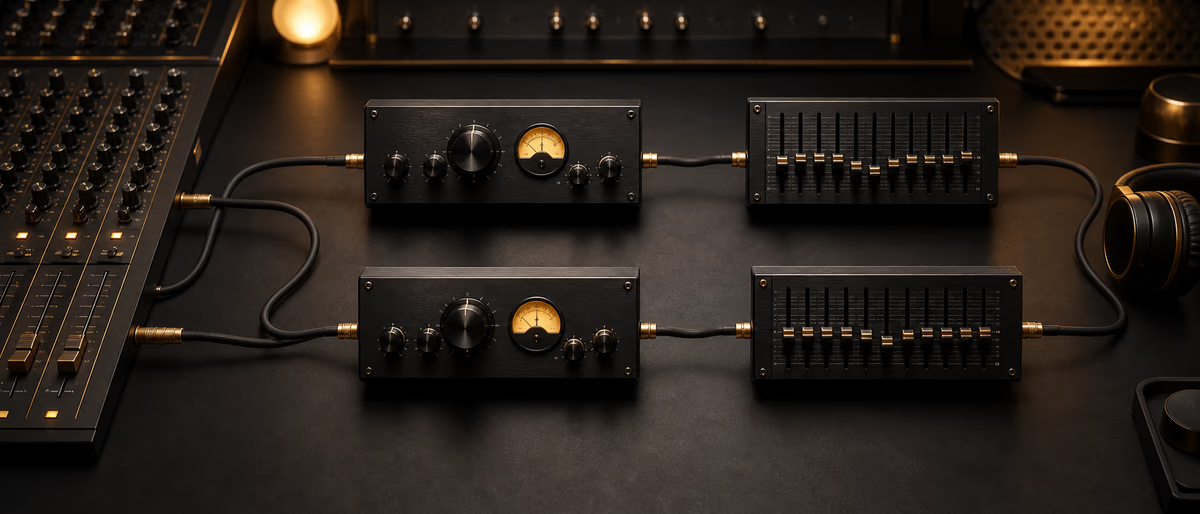
There is no universal law: EQ before compression when you must stop a frequency from triggering the compressor; compression before EQ when you want the compressor to react to the natural balance, then tone-shape the already-controlled signal. Most pro chains use both—subtractive EQ pre, polish EQ post.
Why Plugin Order Changes the Sound
Compressors react to level. Equalizers change level per frequency. Put a huge 3 kHz boost before a compressor and the compressor will grab every sibilant and pick attack as if the whole track got louder. Put that same boost after, and the compressor sees a calmer signal while the boost rides on top of already-smoothed dynamics.
Neither order is “more professional.” What matters is which problem you are solving: too much dynamic range, a resonant build-up, masking, or tone that only appears after the compressor flattens peaks.
Treat order as a decision tree, not a superstition. If you cannot explain why a band is pre or post, you are guessing—and guessing is why vocal chains get muddy at −8 LUFS on the mix bus.
Decision Rules You Can Actually Use
- Resonance triggers gain reduction Cut the resonance with EQ (or dynamic EQ) before the compressor so the detector is not married to one note or string buzz.
- You want punch from the compressor’s character Compress first (or early), then EQ. FET/VCA color and envelope are part of the tone; sculpt after they print their attitude.
- Broadband level rides only Compressor first (or clip gain + compressor), mild EQ after. Classic vocal approach when the mic is already decent.
- Surgical cleanup High-pass, notch, de-ess-ish cuts pre; musical shelves and air post. Cleanup should not be gain-reduction fuel.
- Parallel compression Heavy compress on a send; EQ the parallel return so only the useful body/air blends back. Order on the return still follows the same rules.
Source-by-Source Starting Points
| Source | Often better pre-comp | Often better post-comp | Notes |
|---|---|---|---|
| Lead vocal | HPF, boxiness cuts, dynamic de-ess | Presence shelf, air, mild body | Many mixers use EQ → comp → EQ |
| Acoustic guitar | Boom cut, string squeak control | Sparkle, stereo width EQ | Watch 100–250 Hz into optical comps |
| Kick | Sub/click balance if one triggers hard | Click or sub emphasis after glue | Transient shaper may sit before both |
| 808 / bass | Mud filters, mono low cleanup | Harmonic lift after leveling | Sidechain keying is separate from EQ order |
| Drum bus | Harsh cymbal cuts if bus comp pumps | Glue tone, mild smiley face | Don’t overcut pre or bus loses weight |
| Mix bus | Rarely big cuts; fix sources first | Gentle glue EQ after bus comp | Small moves; order still audible |
On trap and modern pop vocals, a common trustworthy chain is: clip gain rides → subtractive EQ / resonance control → compressor (or two light stages) → de-esser → additive EQ → saturation/delay sends. That is “both,” not a religious war.
Dynamic EQ and Multiband: The Middle Path
Dynamic EQ only reduces (or boosts) a band when that band crosses a threshold. It solves the classic dilemma: you need a 3–5 dB cut at 3.5 kHz only on the harsh words, not on the whole intimate verse. In many sessions, dynamic EQ replaces a static pre-comp cut and a static post-comp boost fight.
Multiband compression is related but different: it splits the signal into bands and compresses each band’s dynamics. Use multiband when the problem is uneven energy over time (boomy chorus, spiky hi-hats), not when you simply need a static tone shift.
If you are still learning, master static EQ + one broadband compressor before stacking three dynamic tools. Complexity is not clarity.
A 10-Minute Order Test Workflow
Loudness-matched A/B is mandatory. A brighter post-EQ chain always wins a biased test if it is also louder. Use a meter or a utility gain flip so you judge tone and dynamics, not volume.[1]
Myths Worth Retiring
Myth: “Always EQ into the compressor like an analog console.” Consoles had channel EQ before dynamics for historical reasons; digital inserts let you choose. Myth: “Mastering engineers never compress before EQ.” Mastering chains vary; many use gentle broadband dynamics then EQ, or mid-side EQ then limiting—context rules.[2]
Myth: “Linear-phase EQ must come last.” Linear-phase tools have latency and pre-ring tradeoffs; use them when phase integrity across a bus matters, not as a default badge.
Practice Plan
Take one vocal, one acoustic guitar, and one drum bus from a real song. For each, build only two chains: EQ→comp→EQ and comp→EQ. Export six loudness-matched clips. Note which order preserved consonants, which controlled resonances, and which made the bus pump. That notebook becomes faster than any forum thread.
When you need free or paid EQ and compressor tools for this practice, the Plugg Supply software library is a practical place to gather verified plugins without tab-hopping random hosts.
Stock your chain with solid free and pro EQ/compressor tools—browse verified software on Plugg Supply, then upgrade on-demand processing when you need it.
Learning path
Related answer hubs
Related articles
![Udemy Meet The Orchestra [TUTORiAL]](/images/posts/udemy-meet-the-orchestra-86341.avif?v=2026080101)
LEARNING / VIDEO TUTORIALS
Udemy Meet The Orchestra [TUTORiAL]
![Truefire Song Lesson Friend of the Devil by The Grateful Dead (JamPlay) [TUTORiAL]](/images/posts/truefire-song-lesson-friend-of-the-devil-by-the-grateful-dea-86196.avif?v=2026080101)
LEARNING / VIDEO TUTORIALS
Truefire Song Lesson Friend of the Devil by The Grateful Dead (JamPlay) [TUTORiAL]
![Truefire Tyler Grant's Country Genre Study (JamPlay) [TUTORiAL]](/images/posts/truefire-tyler-grants-country-genre-study-jamplay-86198.avif?v=2026080101)
LEARNING / VIDEO TUTORIALS
Truefire Tyler Grant's Country Genre Study (JamPlay) [TUTORiAL]
![Udemy Sound Collection and Music Creation [TUTORiAL]](/images/posts/udemy-sound-collection-and-music-creation-86268.avif?v=2026080101)
LEARNING / VIDEO TUTORIALS
Udemy Sound Collection and Music Creation [TUTORiAL]
![MixWithTheMasters Kevin Parker Producing 'Dracula' [TUTORiAL]](/images/posts/mixwiththemasters-kevin-parker-producing-dracula-86234.avif?v=2026080101)
LEARNING / VIDEO TUTORIALS
MixWithTheMasters Kevin Parker Producing 'Dracula' [TUTORiAL]
![Music Hackspace Getting Started with by Phelan Kane [TUTORiAL]](/images/posts/music-hackspace-getting-started-with-by-phelan-kane-86250.avif?v=2026080101)
LEARNING / VIDEO TUTORIALS
Music Hackspace Getting Started with by Phelan Kane [TUTORiAL]
Frequently Asked Questions
- Is EQ before compression always better for vocals?
- No. It is better when low-end plosives or harsh resonances are triggering the compressor. If the vocal is already balanced, compressing first then polishing with EQ often sounds more natural.
- Should I put a de-esser before or after compression?
- Try after the main compressor if compression elevates sibilance, or before if esses already slam the detector. Many chains use a light pre and a finishing de-ess post.
- Does plugin latency change the musical order?
- DAW delay compensation keeps tracks aligned, but look-ahead compressors and linear-phase EQs still change feel and CPU. Order for sound first, then manage latency on tight rhythmic stacks.
- Where do saturators sit relative to EQ and compression?
- Pre-comp saturation can create harmonics the compressor will react to; post-comp saturation colors a more level signal. Decide whether you want the compressor to “hear” the drive.
- What about guitar amp sims?
- Amp/cab tone often comes before mix compression. Use EQ after the sim to fit the track; use compression to control performance dynamics either before the sim (playing feel) or after (mix control).
- Can I use the same order on every channel strip?
- You can start from a template, but sources differ. Reassess whenever gain reduction looks tied to one frequency or the tone only works when the compressor is bypassed.
- How do I A/B orders fairly?
- Match output loudness, disable solo-in-place surprises, and compare in context of the full mix—not only in solo—because masking changes which order wins.
- Is dynamic EQ “cheating” instead of learning order?
- No. Dynamic EQ is a precision tool. Still learn static order so you know when a simple pre cut plus broadband compressor is enough.