
Quick Answer
Budget home foley is a quiet corner, a decent mic, shelves of props, and layered editing—not a Hollywood stage—done with sync discipline and noise control so footsteps and hand props feel real on picture.
What Foley Is (In Practical Terms)
Foley recreates everyday physical sounds in sync with picture: footsteps, cloth, hand props, hugs, keyboards, plates. It fills the emotional tactile layer that production mics often miss or that ADR stages remove.
Home foley will not match a dedicated stage’s noise floor and surface variety on day one—but for indie films, YouTube docs, and game prototypes, careful home work beats silence or lazy library loops that never match gait.
Separate foley from general field recording: foley is performed to picture with intentional sync; field recording captures environments. You will often combine both. [1]
Space and Gear on a Budget
Pick the quietest room at the quietest hour. Soft furnishings help; hard kitchens ring. Turn off HVAC if safe, unplug noisy fridges during takes, and put phone notifications to death.
A large-diaphragm condenser or a solid dynamic + simple interface is enough to start. A small diaphragm pair helps for stereo props later. Buy a decent stand and shockmount before exotic vintage mics.
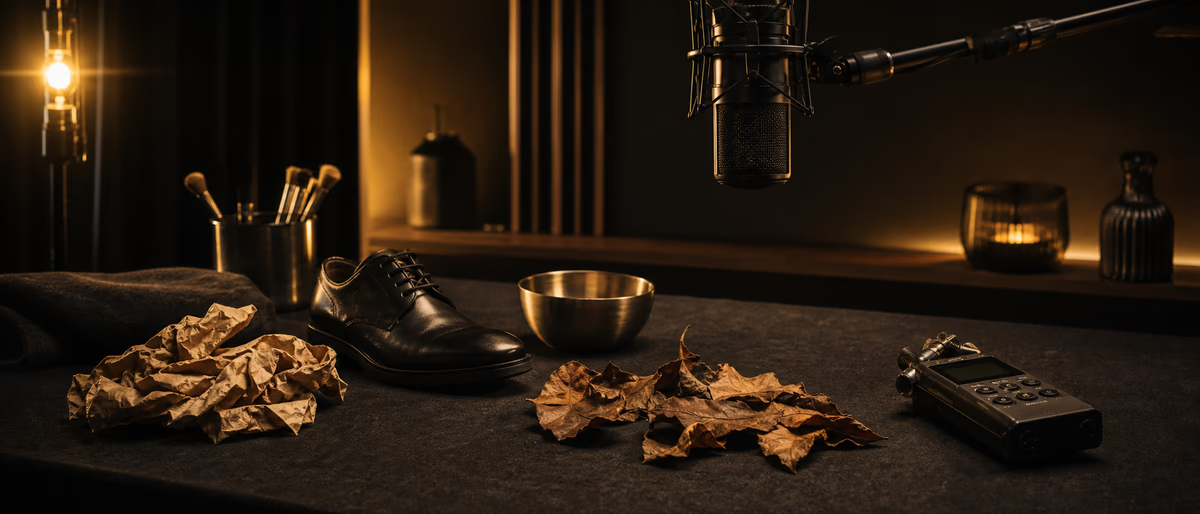
Surfaces matter more than mic brands: wood boards, concrete pavers, carpet scraps, gravel trays, and jackets create footstep worlds. Build a prop shelf from thrift stores: gloves, bags, utensils, keys, paper types. [2]
| Need | Budget approach | Upgrade later |
|---|---|---|
| Footsteps | Board + shoes collection | Multiple surface pits |
| Cloth | Varied shirts/jackets | Dedicated cloth mic setup |
| Hands/props | Thrift drawer of objects | Custom breakables safe area |
| Quiet | Blankets + time-of-day | Treated iso booth |
| Monitoring | Closed headphones | Lower latency interface |
Performance and Mic Technique
- Watch the picture Perform to mute video with burned-in timecode when possible; hit weight changes on stairs and turns.
- Mic distance Too close exaggerates; too far invites room tone. Find the believable middle for the shot size.
- Shoes are instruments Match heel hardness to character. Mismatched shoes break immersion instantly.
- Cloth layering Record cloth separately from feet so the mixer can balance intimacy.
- Safety No dangerous breakables without eye protection and a plan—sound is not worth injuries.
Editing and Delivery
- Sync roughly while recording
Get close; fine nudge in the DAW after. - Top and tail noise
Remove chair squeaks and page turns that are not in the shot. - Layer complementary takes
Soft + hard foot layers sell weight better than one harsh take. - EQ for realism
High-pass rumble; tame harsh spikes; match shot distance with HPF/LPF gently. - Print stems
Feet, cloth, props separately when the mixer wants control. - Keep a prop diary
Which shoes for which character—continuity across recuts.
Loudness should sit under dialogue naturally. Foley that fights VO is a fail even if the footsteps are heroic. Coordinate with the dialogue editor’s world. [3]
When to Use Libraries vs Perform
Libraries excel at explosions, vehicles, and rare props you cannot safely record. Perform what benefits from custom sync: the hero’s gait, a unique bag, a specific kitchen. Hybrid is professional, not cheating.
If you sell foley packs, label surfaces and shoes, include variations, and avoid copyrighted TV playing in the background of takes.
Build personal libraries from each project. Your homemade gravel and coat will become faster than shopping online mid-deadline.
Practice Drills and Client-Ready Presentation
Drill one: mute a dialogue scene and perform only footsteps for ninety seconds of picture. Record three takes, comp the best, and compare against commercial films in a similar space. Drill two: cloth-only pass on an emotional close-up. Drill three: kitchen props with correct perspective shifts as the camera moves closer.
Present work to clients as stems with a short notes PDF: mic used, surfaces, known limitations (exterior scenes recorded interior, etc.). Honesty builds trust and invites the mixer to enhance rather than discard your work.
Price home foley realistically. Your quiet hours, prop shopping, and editing time are the product. Free “experience” gigs should be rare and portfolio-strategic, not the default.
Health matters: repetitive knee stress from footstep sessions is real—use anti-fatigue mats, rotate shoes, and take breaks. Hearing health: do not monitor too loud while hunting tiny cloth details.
As you grow, consider a small iso closet upgrade, better preamps, and organized prop crates labeled by surface. The budget path is iterative: each paid short funds the next shelf of shoes, not an impulse flagship mic that does not fix a noisy room.
Collaborate with editors early so cut points do not force impossible sync later. If a montage is still fluid, provide flexible elements rather than frame-locked performances that break on the next export.
Keep learning from classic foley craft interviews and post-production breakdowns, then adapt methods to your apartment constraints. The craft is observation of real life—watch how jackets actually move when people sit, then perform that truth.
A 90-Day Budget Roadmap
Month 1: quiet room + mic + five surfaces + ten shoes/cloth items; practice to public domain picture. Month 2: prop drawer expansion and stereo experiments. Month 3: full short film scene delivery with stems and notes.
Spend first on acoustic quiet and props, second on mics, third on fancy preamps. Skills compound faster than shopping carts.
Join communities for critique, but test advice against your room—every home has different noise demons.
Combine performed foley with strong library textures—explore Plugg Supply samples when you need beds and FX that support your home stage.
Learning path
Related answer hubs
Related articles
![Music Hackspace Synthesis with Max: Granular by Phelan Kane [TUTORiAL]](/images/posts/music-hackspace-synthesis-with-max-granular-by-phelan-kane-86602.avif?v=2026080101)
LEARNING / VIDEO TUTORIALS
Music Hackspace Synthesis with Max: Granular by Phelan Kane [TUTORiAL]
![Music Hackspace Synthesis with Max: FM by Ned Rush [TUTORiAL]](/images/posts/music-hackspace-synthesis-with-max-fm-by-ned-rush-86583.avif?v=2026080101)
LEARNING / VIDEO TUTORIALS
Music Hackspace Synthesis with Max: FM by Ned Rush [TUTORiAL]
![True Sound Music Library INITIATION [TUTORiAL]](/images/posts/true-sound-music-library-initiation-85302.avif?v=2026080101)
LEARNING / VIDEO TUTORIALS
True Sound Music Library INITIATION [TUTORiAL]
![Tus Clases De Guitarra Tecnicas y Recursos [TUTORiAL]](/images/posts/tus-clases-de-guitarra-tecnicas-y-recursos-86551.avif?v=2026080101)
LEARNING / VIDEO TUTORIALS
Tus Clases De Guitarra Tecnicas y Recursos [TUTORiAL]
![789ten The DubVision Producer Pack v.6 [WAV, MiDi, Synth Presets, TUTORiAL]](/images/posts/789ten-the-dubvision-producer-pack-v6-86546.avif?v=2026080101)
Samples / Presets / MIDI / VIDEO TUTORIALS
789ten The DubVision Producer Pack v.6 [WAV, MiDi, Synth Presets, TUTORiAL]
![Truefire Melodic Trevor Gordon Hall's Melodic Picking Practice Plan (JamPlay) [TUTORiAL]](/images/posts/truefire-melodic-trevor-gordon-halls-melodic-picking-practic-86171.avif?v=2026080101)
LEARNING / VIDEO TUTORIALS
Truefire Melodic Trevor Gordon Hall's Melodic Picking Practice Plan (JamPlay) [TUTORiAL]
Frequently Asked Questions
- Can I record foley with a USB mic?
- Yes for learning and some indie work. Focus on performance and quiet; upgrade when noise floor or flexibility blocks paying jobs.
- How quiet does the room need to be?
- Quiet enough that noise is not obvious under the mix at normal dialogue levels. Measure by listening in context, not only empty-room paranoia.
- Do I need a pit for footsteps?
- Helpful, not mandatory on day one. Boards and rugs already cover many scenes.
- Should foley be mono or stereo?
- Often mono sources panned to picture; stereo for wider props/environments. Ask the mixer’s preference.
- How do I match exterior footsteps at home?
- Use exterior-like surfaces and add subtle exterior bed under; or record safe outdoor takes when weather allows.
- What sample rate?
- Match the project—48 kHz is common for video. 24-bit depth always.
- Is cloth foley really necessary?
- For intimate drama, yes—it sells human presence. For wide action, it may sit lower but still helps.
- Can I layer library footsteps under mine?
- Yes carefully for weight. Avoid flams and double attacks that sound like four legs.