
Quick Answer
Mid-side EQ lets you treat the center (kick, bass, lead vocal) differently from the sides (reverbs, wide guitars, pads). On masters, use small moves: tidy side mud, add gentle side air, and keep sub energy mostly mono—always check mono fold-down.
What Mid-Side EQ Actually Changes
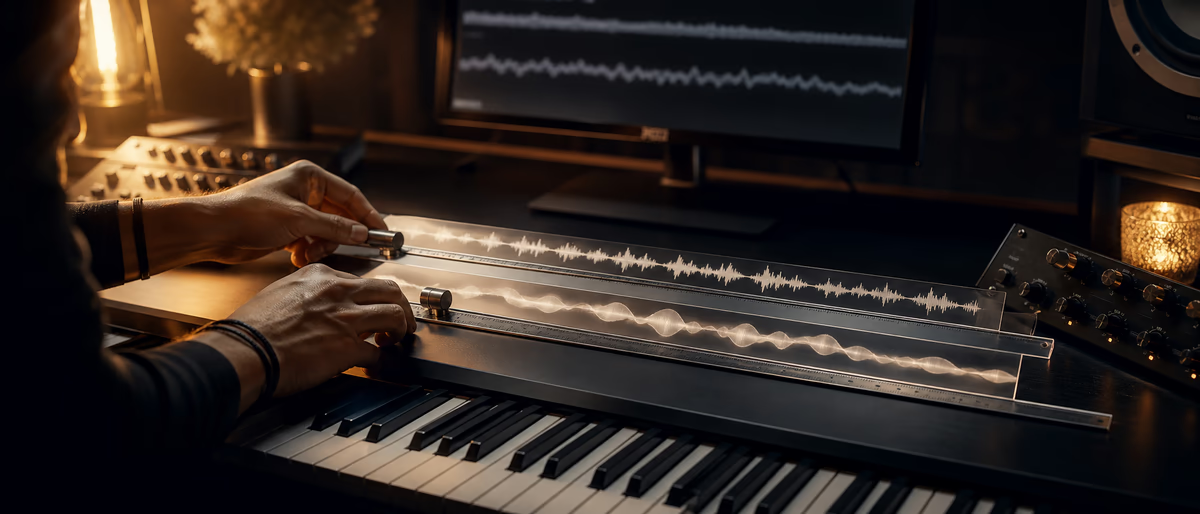
A conventional stereo EQ processes left and right channels with the same curve. Mid-side (M/S) EQ encodes the stereo signal into a Mid channel (shared content, roughly L+R) and a Side channel (difference content, roughly L−R), lets you EQ each, then decodes back to L/R.[1]
On a master or mix bus, that means you can brighten wide cymbals without thinning the vocal, or cut boxy 300–500 Hz on the sides without hollowing the kick. It is not a magic width knob—extreme side boosts can inflate the image while destroying mono compatibility on club systems and phones.
Use M/S EQ after balance and corrective stereo EQ are mostly done. If the mix is wrong in the midrange, M/S will not rescue arrangement problems; it only redistributes energy between center and edges.
When M/S EQ Helps on a Master
- Side mud Wide guitars, pads, or room mics pile up around 200–500 Hz. A narrow side cut cleans width without killing body.
- Center focus A gentle mid presence lift (2–5 kHz) can help vocal intelligibility if the sides are already bright.
- Air without sibilance Shelf the sides above ~10 kHz instead of boosting the whole stereo file into harshness.
- Low-end mono discipline High-pass or gently cut side energy below ~120–150 Hz so subs stay centered on large systems.
- Translation issues If headphones sound huge but mono/phone collapses, inspect side low-mids and exaggerated side highs.
Skip M/S EQ when the problem is overall tonality. A simple stereo EQ or match-EQ against a reference is faster for global brightness or darkness. Skip it on already narrow, mono-heavy electronic masters where sides carry little useful information.
Starting Moves and Guardrails
| Goal | Channel | Starting move | Watch for |
|---|---|---|---|
| Tighter sub | Side | HPF or −1 to −3 dB shelf below 120 Hz | Losing stereo bass intentionality |
| Less wide mud | Side | −1 to −2 dB bell at 250–400 Hz | Dry, lifeless pads |
| Clearer vocal | Mid | +0.5 to +1.5 dB at 2.5–4 kHz | Harsh consonants |
| Polite air | Side | +0.5 to +1.5 dB shelf ~10–12 kHz | Cymbal glare on earbuds |
| Less center boom | Mid | −1 dB at 150–250 Hz | Thin kick body |
Keep gains small. On a master, 0.5–2 dB is real work; 6 dB moves usually mean the mix should go back. Solo Mid and Side briefly to hear the problem, then mix in context. Always A/B at matched loudness—M/S EQ can change perceived loudness and trick you into preferring the louder pass.
Insert order matters. Typical mastering order might be corrective EQ → dynamics → M/S EQ for image polish → limiter. Some engineers put mild M/S earlier; what matters is not painting yourself into mono-incompatible corners before the limiter exaggerates them.
Mono, Correlation, and Playback Checks
Fold to mono after every meaningful side boost. If the chorus thins, reverb vanishes, or the snare loses body, your side curve is fighting the arrangement. A correlation meter should not sit pinned near −1; aim for generally positive correlation with brief dips that recover.[2]
Check on headphones for width comfort, on a phone speaker for mid focus, and on a single mono speaker or summed monitor path for club-style collapse. Phone speakers are ruthless midrange truth-tellers; if the hook disappears, fix mid balance before more side glitter.
True peak and integrated loudness still apply. Spotify’s loudness normalization guidance remains a useful reference for streaming delivery targets; M/S EQ should not push you into excessive limiting just to keep a wide, bright master competitive.[3]
Tools: Free and Paid Options
Many modern EQs include an M/S mode: TDR Nova (dynamic EQ with flexible routing), stock M/S utilities in major DAWs, FabFilter Pro-Q, iZotope Ozone’s EQ module, and others. You can also use a free M/S encoder/decoder pair around a conventional EQ if your EQ lacks a native mode.
Dynamic M/S EQ is powerful for problem resonances that only appear on wide sections. Use it sparingly on masters—pumping sidebands can sound like a broken imager. Prefer static, musical curves first.
Common Mistakes
Widening by boosting side mids and highs indiscriminately creates a “hi-fi demo” that fails mono. Cutting too much mid low-end to fake punch makes streaming transcodes feel thin. Using M/S EQ to hide phasey stereo enhancers is treating symptoms—fix the enhancer or the layered samples first.
Another trap: different M/S curves on every song of an album without a shared vision. Keep a template of subtle defaults, then customize per track. Consistency of image across an EP often matters more than maximal width on one single.
Practical Summary
Mid-side EQ is a surgical imaging and clarity tool for masters, not a substitute for arrangement or static balance. Keep energy centered in the low end, clean side mud, add air carefully, and verify mono. If you need more than a couple of decibels, send the mix back—masters should polish, not rebuild.
Explore free EQ and metering tools in the Plugg Supply software library for cleaner masters.
Learning path
Related answer hubs
Related articles
![Udemy Singing Mastery Holistic Method To Sing Freely [TUTORiAL]](/images/posts/udemy-singing-mastery-holistic-method-to-sing-freely-86017.avif?v=2026080101)
LEARNING / VIDEO TUTORIALS
Udemy Singing Mastery Holistic Method To Sing Freely [TUTORiAL]
![Tus Clases De Guitarra Guitarra Rítmica [TUTORiAL]](/images/posts/tus-clases-de-guitarra-guitarra-ritmica-85925.avif?v=2026080101)
LEARNING / VIDEO TUTORIALS
Tus Clases De Guitarra Guitarra Rítmica [TUTORiAL]
![Lucid RnB Alchemy [WAV, MiDi, Synth Presets, TUTORiAL]](/images/posts/lucid-rnb-alchemy-85746.avif?v=2026080101)
Samples / Presets / MIDI / VIDEO TUTORIALS
Top 5%Lucid RnB Alchemy [WAV, MiDi, Synth Presets, TUTORiAL]
![Truefire Bass Soloing Studies Vol.2 [TUTORiAL]](/images/posts/truefire-bass-soloing-studies-vol2-85693.avif?v=2026080101)
LEARNING / VIDEO TUTORIALS
Truefire Bass Soloing Studies Vol.2 [TUTORiAL]
![MixWithTheMasters Beck Recording and Producing Ride Lonesome [TUTORiAL]](/images/posts/mixwiththemasters-beck-recording-and-producing-ride-lonesome-86013.avif?v=2026080101)
LEARNING / VIDEO TUTORIALS
MixWithTheMasters Beck Recording and Producing Ride Lonesome [TUTORiAL]
![Nimda 115 Growly Sustain And Stab From Brass Sample [TUTORiAL]](/images/posts/nimda-115-growly-sustain-and-stab-from-brass-sample-85964.avif?v=2026080101)
LEARNING / VIDEO TUTORIALS
Nimda 115 Growly Sustain And Stab From Brass Sample [TUTORiAL]
Frequently Asked Questions
- Is mid-side EQ the same as a stereo widener?
- No. Wideners exaggerate side level or create artificial differences. M/S EQ shapes frequency content of mid vs side. You can widen perception slightly with side highs, but mono checks still rule.
- Should sub bass be mid-only?
- Usually yes for club and streaming translation—keep most energy below ~100–120 Hz centered. Intentional stereo bass exists in some genres; verify mono carefully if you keep it.
- Can I use mid-side EQ while mixing, not only mastering?
- Yes on buses (vocals, guitars, master). Prefer fixing individual tracks first so the bus stays light.
- Why does my mix disappear in mono after M/S EQ?
- Side boosts added content that cancels or loses level when L and R sum. Reduce side low-mids/highs or fix phasey layers upstream.
- How much mid-side EQ is safe on a master?
- Think in half-dB to 2 dB moves. Larger changes usually belong in the mix.
- Do free EQs support mid-side?
- Several do, including TDR Nova and various DAW stock tools. You can also encode/decode around any EQ.
- Where should M/S EQ sit relative to the limiter?
- Typically before the final limiter so you hear the true limited result, after major tonal EQ and dynamics.