
Quick Answer
Atmos music mixes place sounds in a 3D bed + objects field, not only left-right. Start from a strong stereo mix, keep dialogue-like leads readable, monitor carefully (or use binaural), and follow current distributor/Dolby delivery specs—verify as of 2026.
What Changes Versus Stereo
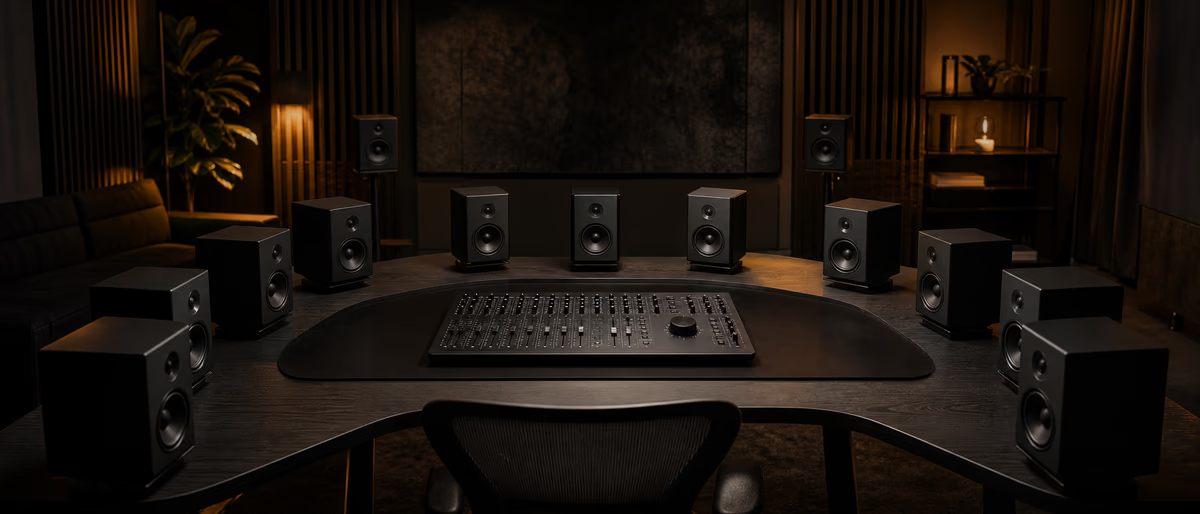
In channel-based stereo, you pan on a line. In Dolby Atmos Music, you can position sounds in a three-dimensional field using beds (channel-based beds such as 7.1.2-style layouts depending on configuration) and objects with metadata for location and size.[1]
The artistic goal is immersion without losing the song. If the vocal becomes a floating effect while lyrics die, the spatial mix failed. Most successful Atmos music still treats the lead and low end as anchors near the front/center while decorating with height and surround details.
Apple Music, Tidal, Amazon, and other services distribute spatial titles with their own encoding pipelines. Always check your distributor’s current Atmos acceptance rules before print day—they change more often than stereo WAV specs.
System, DAW, and Monitoring Reality
Native Atmos music production typically needs a compatible DAW/renderer workflow (for example Logic’s spatial tools or other supported hosts with the Dolby Atmos Renderer integration depending on your stack). Verify your DAW version and plugin formats against Dolby’s current documentation rather than assuming “any DAW.”[2]
Speaker-based Atmos rooms are ideal but expensive. Many indie producers draft in binaural headphone monitoring. Binaural is useful for placement decisions yet lies about low end and absolute level—cross-check critical balances on stereo speakers and, when possible, a calibrated room or trusted facility.
CPU and session organization matter: object-heavy sessions explode track counts. Print groups and commit FX when placements are approved.
A Sane Workflow From Stereo to Atmos
Musical Guidelines That Keep Songs Intact
- Lead vocal Usually front-anchored and readable; use height for doubles/FX, not for burying lyrics.
- Low end Keep bass and kick solid and mostly stable; excessive spatialization of sub confuses translation.
- Reverb/ambience Great object/bed candidates—create space without drowning midrange.
- Movement Automate transitions and fills; static songs can still feel spatial with static width/height.
- Fold-down Many listeners still hear stereo or binaural—check that the fold-down is not phase soup.
Loudness for immersive releases has platform-specific guidance. Treat any single LUFS number you read on social media as incomplete—confirm the target in the delivery spec you are printing for, and leave true-peak safety appropriate to the codec path.
Common Mistakes
Spinning the lead vocal around the room, ignoring fold-down phase, overusing LFE, and building Atmos before the stereo arrangement is finished are top failure modes. Another: delivering without checking binaural on consumer headphones the audience actually owns.
Do not claim “Atmos mastered” if you only ran a stereo upmixer preset without musical review. Upmixers are starting points, not automatic quality.
When Atmos Is Worth the Budget
Prioritize Atmos when the release has spatial storytelling (score-like pop, cinematic electronic, premium album campaigns) or when a label/distributor funds it. For a single beat lease, stereo excellence still pays more than a rushed spatial file.
If you offer Atmos as a service, price room time, stem prep, and QC separately. Clients often underestimate stem cleanliness requirements.
Stem Prep Before Spatial Placement
Atmos quality is gated by stem hygiene. Print dry enough stems that reverb and delay can be re-placed in space intentionally; or print FX stems separately so you can park ambiences in height without permanently baking a stereo plate into the lead vocal. Label everything with channel counts, start offsets, and whether limiting is already applied.
Sync offsets matter. If one stem is a sample late, object movement will feel loose against the bed. Bounce from a unified session timeline, include two bars of pre-roll silence if your facility requests it, and never hand over social-media compressed previews as spatial sources.
Dialogue with the stereo mix engineer early. Ask which elements are essential anchors versus decorative. Trying to spatialize every layer equally creates a directionless cloud. Choose heroes: a delay throw that arcs overhead, a percussion answer in surrounds, a pad that blooms in height during the bridge—while the vocal and groove remain readable.
Document loudness and true-peak targets from the distributor on the day of print. Immersive delivery specs evolve; screenshot or PDF the requirement into the session folder so the archive explains why you printed those levels months later.
Summary
Atmos music mixing is song-first spatial design: stable anchors, intentional objects, careful fold-down, and delivery-spec discipline. Start from a great stereo mix, move slowly, and verify on the playback paths your fans use.
Build stronger stereo foundations first—browse tools and samples on Plugg Supply.
Learning path
Related answer hubs
Related articles
![789ten The DubVision Producer Pack v.6 [WAV, MiDi, Synth Presets, TUTORiAL]](/images/posts/789ten-the-dubvision-producer-pack-v6-86546.avif?v=2026080101)
Samples / Presets / MIDI / VIDEO TUTORIALS
Hot789ten The DubVision Producer Pack v.6 [WAV, MiDi, Synth Presets, TUTORiAL]
![Musihacks Jaime Altozano Curso Piano Acompañamientos (Intermedio) [TUTORiAL]](/images/posts/musihacks-jaime-altozano-curso-piano-acompanamientos-interme-82295.avif?v=2026080101)
LEARNING / VIDEO TUTORIALS
HotMusihacks Jaime Altozano Curso Piano Acompañamientos (Intermedio) [TUTORiAL]
![FaderPro The One Hour Mixing Workflow [TUTORiAL]](/images/posts/faderpro-the-one-hour-mixing-workflow-84119.avif?v=2026080101)
LEARNING / VIDEO TUTORIALS
HotFaderPro The One Hour Mixing Workflow [TUTORiAL]
![MixWithTheMasters Kevin Parker Producing 'Dracula' [TUTORiAL]](/images/posts/mixwiththemasters-kevin-parker-producing-dracula-86234.avif?v=2026080101)
LEARNING / VIDEO TUTORIALS
TrendingMixWithTheMasters Kevin Parker Producing 'Dracula' [TUTORiAL]
![Production Music Live Arrangement Academy [TUTORiAL]](/images/posts/production-music-live-arrangement-academy-78917.avif?v=2026080101)
LEARNING / VIDEO TUTORIALS
TrendingProduction Music Live Arrangement Academy [TUTORiAL]
![Truefire Melodic Trevor Gordon Hall's Melodic Picking Practice Plan (JamPlay) [TUTORiAL]](/images/posts/truefire-melodic-trevor-gordon-halls-melodic-picking-practic-86171.avif?v=2026080101)
LEARNING / VIDEO TUTORIALS
TrendingTruefire Melodic Trevor Gordon Hall's Melodic Picking Practice Plan (JamPlay) [TUTORiAL]
Frequently Asked Questions
- Can I mix Atmos on headphones only?
- You can draft in binaural, but critical low-end and level decisions need speaker checks or a trusted facility review when stakes are high.
- Is Atmos required for every release in 2026?
- No. It is optional value for certain platforms and campaigns. Stereo still carries most listening.
- What is the difference between beds and objects?
- Beds are channel-based beds; objects carry positional metadata and can move independently in the renderer.
- Should the LFE carry the whole 808?
- Generally no. Manage low end across the main channels with careful LFE use; dumping full bass into LFE often translates poorly.
- Do I need a full 7.1.4 room?
- Ideal for final QC, not mandatory for learning. Many indies start with supported binaural workflows plus stereo references.
- Will an upmixer replace an Atmos mix?
- Upmixers can create a starting immersive image from stereo, but intentional stem-based mixes usually sound more musical.
- Where do I verify delivery specs?
- Dolby professional resources and your distributor’s current help center—always re-check near release day.