
Layer synths trap
Quick Answer
Thick trap leads usually come from three complementary layers—a centered core for pitch, a brighter octave/air layer for presence, and a short transient or distortion layer for attack—not from one preset turned to 11. Detune carefully, EQ-split the layers, high-pass against the 808, and check mono. Free synths from verified catalogs are enough if the roles are clear.
Why Layer Instead of One Huge Preset
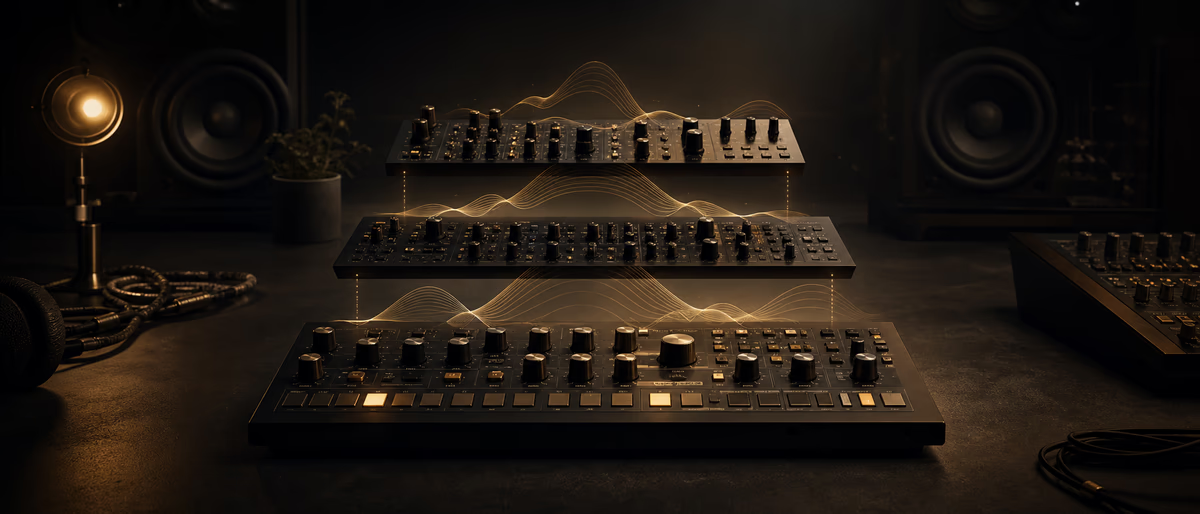
A single preset tries to be body, sparkle, and attitude at once, which makes EQ and automation clumsy. Layering assigns roles: one sound owns fundamental pitch, another owns air and stereo interest, another owns the first milliseconds of attack. You can ride each role independently when the vocal enters or when the 808 takes over.
Layering also improves collab and beat-store workflows. You can mute the scream layer for a clean vocal version, or export a “MIDI + core only” pack for artists who want a simpler topline.
Three-Layer Template for Trap Leads
| Layer | Role | Sound ideas | Mix notes |
|---|---|---|---|
| Core | Pitch identity, mid body | Slightly detuned saw/wave, simple square, soft wavetable | Mostly mono or narrow; sits 200 Hz–2 kHz with care |
| Air / octave | Presence and width | Octave-up thin saw, bell, whispered noise-osc hybrid | HPF higher; wider stereo OK |
| Transient / grit | Attack and attitude | Short pluck, light distortion send, parallel bitcrush | Short amp env; low level; automate in hooks |
Start with volumes: core first until the melody is clear on small speakers, then blend air until headphones smile without harshness, then add grit only where the hook needs aggression. If you cannot sing the melody with only the core layer, fix the core before stacking candy.
Detune Rules That Stay Musical
Classic supersaw energy uses small cent offsets, not random chaos. Try ±5–10 cents on secondary oscillators; keep the core oscillator more stable so Auto-Tune-style vocalists and 808s still hear a center pitch. Chorus plugins can fake width after mono layers if detune fights the key.
Octave layers should be intentionally quieter and often thinner EQ-wise. A full-loud octave-up saw will read as a new melody and crowd hats. Fifths can sound anthemic or medieval—use sparingly in dark trap.
If two layers create a slow phasing whoosh, nudge timing by a few milliseconds, flip phase on one layer, or narrow the stereo of one source.
EQ Splitting So Layers Do Not Fight
- Core owns body Allow the main midrange. Cut competing lows that the 808 already owns.
- Air owns top High-pass freely (often 400 Hz–1 kHz+) and dip harsh 2.5–5 kHz if hats exist.
- Grit owns edges Band-pass distortion layers so they add bite without broadband noise.
- Dynamic carving When the vocal arrives, automate a small mid dip on the lead bus rather than permanently thinning the beat version.
- Shared bus glue Light bus compression or tape on the lead group after each layer is balanced—do not compress each layer into lifelessness first.
Phase, Stereo, and Mono Checks
Layered oscillators and multiple stereo imagers can cancel in mono. Flip the mono button on your monitoring chain (or a utility plugin) while the hook plays. If the lead collapses or loses the root note, narrow the core layer and reserve width for the air layer.
Align sample-based layers at transients. A slapped pluck 10 ms late feels thick in a bad way. For MIDI layers, the same clock is fine; problems usually come from different envelope attack times—match perceived attack by ear.
Mid/side EQ: consider keeping mid (center) energy clean for TikTok/phone mono playback while sides carry sparkle.
Gain Stage Before the Lead Bus
If each layer peaks near 0 dBFS, the bus compressor and any saturator will smash unpredictably. Peak each layer lower, aim for a bus with headroom, then decide on glue. Loudness is a master-bus problem later; clarity is a layering problem now.
Name channels Core / Air / Grit and color-code them. Future you (and mix engineers) should not reverse-engineer six “Synth 3 copy” tracks.
Leave Space for the 808 and Kick
High-pass the entire lead bus until the sub line stays readable—often somewhere between 100–180 Hz depending on the arrangement. Notch or dynamic-EQ the lead if it masks a vocal formant band the artist lives in.
When 808 notes glide, avoid lead portamento that fights the same glide shape unless intentional unison. Sidechain the lead bus lightly to the kick for punch; over-ducking makes the melody pump cartoonishly.
In drop sections, mute air/grit for a bar so the re-entry hits harder—arrangement is free excitement.
Hook Automation and Performance Tricks
- Filter open into the hook
Automate core or air filter cutoff upward into bar one of the chorus. - Bring grit only on accents
Velocity or clip automation so distortion layer speaks on long notes, not every 1/16. - Octave jumps as arrangement
Duplicate a phrase up an octave with air layer only for the last hook. - Half-time hats moments
Thin the lead (mute air) when percussion gets busy so the beat breathes. - Export options
Print a full lead stem and a core-only stem for vocalists who need space.
Preset Discipline and CPU
Three simple synth instances often cost less CPU than one mega-preset with four unison voices, four effects, and oversampling everywhere—especially if you freeze/flatten after sound design. Disable unused effects inside each instance.
Save a track template: Core/Air/Grit buses pre-routed with your go-to EQ shapes. Speed encourages better writing because you stop rebuilding architecture every beat.
Verified Tools on Plugg Supply
Free synths and utility plugins from Plugg Supply’s checked catalog help you match layers across machines. Telegram delivery keeps installers consistent for remote collaborators.
- Browse instruments
Find wavetable or virtual-analog freebies suitable for core and air roles. - Add utilities
Grab free EQ/saturation tools for bus glue after layers are balanced.
Build a Core/Air/Grit lead template on your next beat, mono-check it, then browse verified free synths if you need a new flavor for one role.
Learning path
Related answer hubs
Genre feed
Trap materials from the feed
Loops, one-shots, presets and catalog drops that match the Trap production lane.
![Jackwya Delta Serum 2 Bank [Synth Presets]](/images/posts/jackwya-delta-serum-2-bank-86633.avif?v=2026080101)
![Venexxi x Aye Shark Zenology Bank [WAV, Synth Presets]](/images/posts/venexxi-x-aye-shark-zenology-bank-82238.avif?v=2026080101)
![9anyal Floral Multi Kit [WAV, MiDi, FLP, FST]](/images/posts/9anyal-floral-multi-kit-83455.avif?v=2026080101)
Samples / MIDI / PROJECTS,TEMPLATES
9anyal Floral Multi Kit [WAV, MiDi, FLP, FST]
![Eazybeats Firstlight Multikit [WAV, MiDi, Synth Presets, DAW Templates]](/images/posts/eazybeats-firstlight-multikit-86078.avif?v=2026080101)
Samples / Presets / MIDI / PROJECTS,TEMPLATES
Eazybeats Firstlight Multikit [WAV, MiDi, Synth Presets, DAW Templates]
Related articles
![789ten The DubVision Producer Pack v.6 [WAV, MiDi, Synth Presets, TUTORiAL]](/images/posts/789ten-the-dubvision-producer-pack-v6-86546.avif?v=2026080101)
Samples / Presets / MIDI / VIDEO TUTORIALS
Hot789ten The DubVision Producer Pack v.6 [WAV, MiDi, Synth Presets, TUTORiAL]
![Musihacks Jaime Altozano Curso Piano Acompañamientos (Intermedio) [TUTORiAL]](/images/posts/musihacks-jaime-altozano-curso-piano-acompanamientos-interme-82295.avif?v=2026080101)
LEARNING / VIDEO TUTORIALS
HotMusihacks Jaime Altozano Curso Piano Acompañamientos (Intermedio) [TUTORiAL]
![FaderPro The One Hour Mixing Workflow [TUTORiAL]](/images/posts/faderpro-the-one-hour-mixing-workflow-84119.avif?v=2026080101)
LEARNING / VIDEO TUTORIALS
HotFaderPro The One Hour Mixing Workflow [TUTORiAL]
![MixWithTheMasters Kevin Parker Producing 'Dracula' [TUTORiAL]](/images/posts/mixwiththemasters-kevin-parker-producing-dracula-86234.avif?v=2026080101)
LEARNING / VIDEO TUTORIALS
TrendingMixWithTheMasters Kevin Parker Producing 'Dracula' [TUTORiAL]
![Production Music Live Arrangement Academy [TUTORiAL]](/images/posts/production-music-live-arrangement-academy-78917.avif?v=2026080101)
LEARNING / VIDEO TUTORIALS
TrendingProduction Music Live Arrangement Academy [TUTORiAL]
![Truefire Melodic Trevor Gordon Hall's Melodic Picking Practice Plan (JamPlay) [TUTORiAL]](/images/posts/truefire-melodic-trevor-gordon-halls-melodic-picking-practic-86171.avif?v=2026080101)
LEARNING / VIDEO TUTORIALS
TrendingTruefire Melodic Trevor Gordon Hall's Melodic Picking Practice Plan (JamPlay) [TUTORiAL]
Frequently Asked Questions
- How many synth layers are too many?
- If you cannot explain each layer’s job in one sentence, mute until you can. Three clear roles beat seven accidental copies.
- Why does my layered lead sound thin on phones?
- Too much energy is stereo-only or high-only. Strengthen the mono core midrange and high-pass mud carefully without deleting the body.
- Should every layer be detuned?
- No. Keep a stable core; detune supporting oscillators or the air layer for width.
- Where does distortion go?
- Often on a parallel grit layer or post-bus at low mix. Distorting the only core layer can destroy pitch definition under Auto-Tuned vocals.
- Can I layer presets from different synths?
- Yes—that is often best. Different aliasing and filter flavors create depth free unison cannot.
- How do I stop layers phasing?
- Reduce overlapping detune, flip phase, micro-shift timing, or EQ-split so they do not share identical spectra.
- Do I layer before or after writing the melody?
- Write with a simple core sound first. Add air/grit after the notes and rhythm are right so sound design does not hide weak writing.
- What about MIDI vs audio layers?
- Stay MIDI while designing; print audio for chops, reverses, and stable stems once the part is approved.