
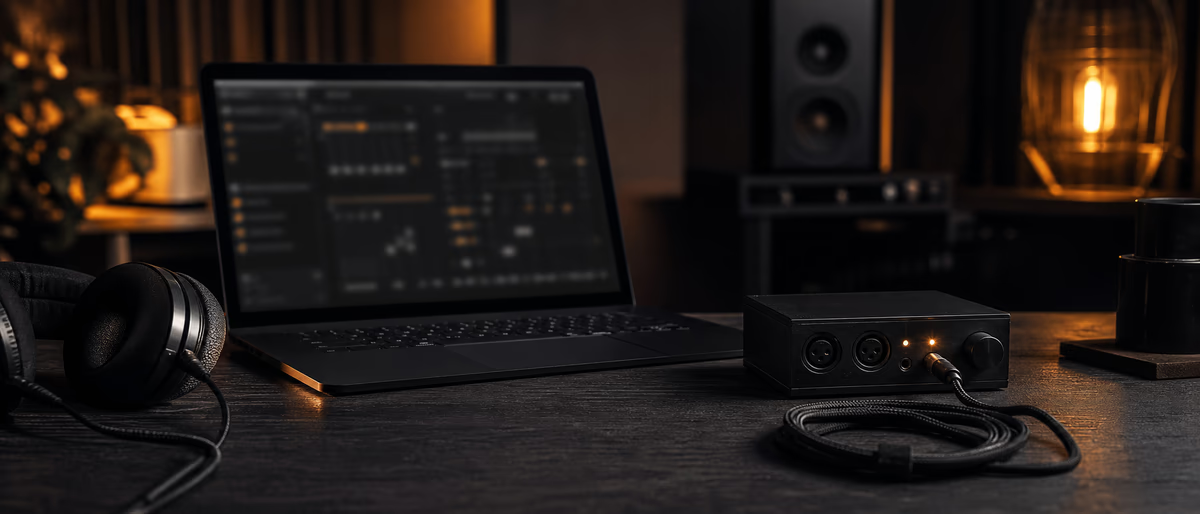
Quick Answer
Windows ASIO problems usually come from wrong drivers, power management, sample-rate mismatches, or background apps stealing the device—work the stack from cable to buffer.
ASIO in One Minute
ASIO is a low-latency driver model used by professional interfaces on Windows. Vendor ASIO drivers generally outperform generic paths for music production. WASAPI exclusive can work, but most studios standardize on the manufacturer ASIO driver. [1]
Symptoms include crackles, dropouts, device-in-use errors, huge latency, or DAWs that will not boot audio. Fix systematically rather than reinstalling random software packs.
Fast Triage Checklist
If stable only at large buffers, you have a performance or conflict issue. Measure DPC latency with reputable tools and update chipset drivers carefully. [2]
Common Conflicts
- Exclusive mode apps Zoom, Discord, browsers holding the device.
- Multiple drivers Generic ASIO wrappers fighting vendor ASIO.
- Sample-rate drift 44.1 project vs 48 interface clock.
- Bluetooth defaults Windows routing to headphones unexpectedly.
- Outdated firmware Known fixed bugs on vendor release notes.
- Overheating hubs Mobile racks with cheap powered hubs.
Buffers, Latency, and Expectations
Tracking vocals often wants lower buffers; mixing can use higher buffers for plugin-heavy sessions. Freeze tracks before forcing tiny buffers. Measure round-trip latency in your DAW rather than believing marketing milliseconds alone.
Driver Hygiene
Uninstall old drivers fully before major upgrades. Reboot between steps. Create a restore point before experimental rolls. Prefer vendor instructions for your exact model. [3]
When Windows updates break audio, check vendor advisories before panic reinstall loops.
Laptop-Specific Notes
Plug in AC power for shows and tracking. Use performance power plans. Reduce hybrid graphics weirdness when possible. Kill RGB bloatware if it hooks system audio.
When to Suspect Hardware
If multiple computers fail with the same interface after clean installs, or the unit disconnects under light load, pursue RMA testing. Software rabbit holes cannot revive failing controllers.
Quality Gates and Field Notes
Turn this guide into a checklist with owners and pass/fail gates. Most failures are skipped verification, not lack of talent. Log incidents and add gates where errors repeat.
Verify public claims against primary vendor or platform documentation each quarter. Names, pricing, and policies change; do not recycle outdated screenshots into product pages.
Teach collaborators with a short walkthrough video plus written steps. Unwritten knowledge disappears when only one person knows the hidden ritual between bullets.
Define rollback: how to restore the last known good version of files, sessions, or drivers. Without rollback, every experiment is a production risk.
- Gate Binary check before shipping
- Owner Named accountable person
- Artifact Bounce, screenshot, commit, or signed note
- Cadence Per release, weekly, or per show
Quality Gates and Field Notes
- Gate Binary check before shipping
- Owner Named accountable person
- Artifact Bounce, screenshot, commit, or signed note
- Cadence Per release, weekly, or per show
Quality Gates and Field Notes
- Gate Binary check before shipping
- Owner Named accountable person
- Artifact Bounce, screenshot, commit, or signed note
- Cadence Per release, weekly, or per show
Quality Gates and Field Notes
- Gate Binary check before shipping
- Owner Named accountable person
- Artifact Bounce, screenshot, commit, or signed note
- Cadence Per release, weekly, or per show
Pair a stable interface setup with free studio tools from Plugg Supply. Visit /premium when you need on-demand processing.
Learning path
Related answer hubs
Related catalog
More tutorials from the catalog
More tutorials from the Plugg Supply feed, ranked by catalog popularity.
![Udemy Meet The Orchestra [TUTORiAL]](/images/posts/udemy-meet-the-orchestra-86341.avif?v=2026080101)
LEARNING / VIDEO TUTORIALS
Udemy Meet The Orchestra [TUTORiAL]
![Truefire Song Lesson Friend of the Devil by The Grateful Dead (JamPlay) [TUTORiAL]](/images/posts/truefire-song-lesson-friend-of-the-devil-by-the-grateful-dea-86196.avif?v=2026080101)
LEARNING / VIDEO TUTORIALS
Truefire Song Lesson Friend of the Devil by The Grateful Dead (JamPlay) [TUTORiAL]
![Truefire Tyler Grant's Country Genre Study (JamPlay) [TUTORiAL]](/images/posts/truefire-tyler-grants-country-genre-study-jamplay-86198.avif?v=2026080101)
LEARNING / VIDEO TUTORIALS
Truefire Tyler Grant's Country Genre Study (JamPlay) [TUTORiAL]
![Udemy Sound Collection and Music Creation [TUTORiAL]](/images/posts/udemy-sound-collection-and-music-creation-86268.avif?v=2026080101)
LEARNING / VIDEO TUTORIALS
Udemy Sound Collection and Music Creation [TUTORiAL]
Related articles
LEARNING / VIDEO TUTORIALS
Udemy Meet The Orchestra [TUTORiAL]
LEARNING / VIDEO TUTORIALS
Truefire Song Lesson Friend of the Devil by The Grateful Dead (JamPlay) [TUTORiAL]
LEARNING / VIDEO TUTORIALS
Truefire Tyler Grant's Country Genre Study (JamPlay) [TUTORiAL]
LEARNING / VIDEO TUTORIALS
Udemy Sound Collection and Music Creation [TUTORiAL]
![MixWithTheMasters Kevin Parker Producing 'Dracula' [TUTORiAL]](/images/posts/mixwiththemasters-kevin-parker-producing-dracula-86234.avif?v=2026080101)
LEARNING / VIDEO TUTORIALS
MixWithTheMasters Kevin Parker Producing 'Dracula' [TUTORiAL]
![Music Hackspace Getting Started with by Phelan Kane [TUTORiAL]](/images/posts/music-hackspace-getting-started-with-by-phelan-kane-86250.avif?v=2026080101)
LEARNING / VIDEO TUTORIALS
Music Hackspace Getting Started with by Phelan Kane [TUTORiAL]
Frequently Asked Questions
- ASIO4ALL?
- Last resort wrapper; prefer vendor ASIO when available.
- Best buffer size?
- Lowest stable for the task; no universal number.
- Brand specific?
- Always use brand instructions for your model.
- Wi-Fi dropouts?
- Sometimes; test offline to compare.
- Sample rate?
- 44.1 or 48 common—consistency matters most.
- Multiple interfaces?
- Get stable on one first.
- Safe mode testing?
- Useful to rule out third-party software conflicts.